From Burnout to Buyouts: What Two Business Exits Taught John Doherty About Profit, Pricing, and Freedom
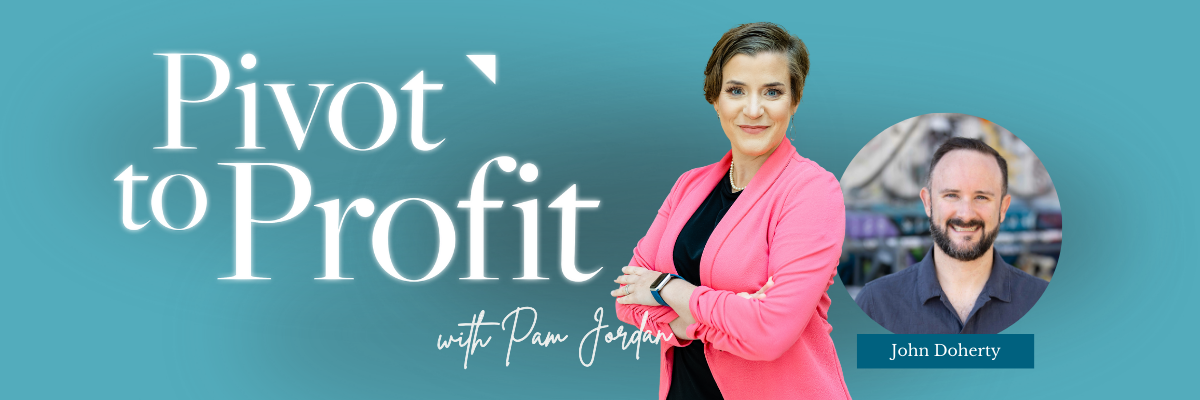
On this episode of the Pivot to Profit Podcast, Pam Jordan sits down with serial entrepreneur and digital marketing veteran John Doherty, a founder who has successfully exited two agencies—one to private equity and one to a competitor. His journey offers powerful lessons for business owners who want to build profitable companies without sacrificing their freedom.
John’s entrepreneurial path began after being laid off from Zillow. Instead of jumping back into a corporate role, he gave himself six months to replace his income. Within eight weeks, he had doubled his previous salary through specialized SEO consulting. That early win reinforced a core principle: specialization creates value—and value drives profit.
He later built Credo, a lead generation company for digital agencies, and grew it into a highly profitable business. But despite strong margins and consistent cash flow, burnout set in. In 2022, after 18 months of conversations, John sold Credo to a private equity firm that owned one of his largest customers.
While the sale made sense personally, he admits that financially, he could have structured things differently. One key lesson? Profitability alone isn’t enough. How you manage and reinvest profit determines whether a business can scale sustainably.
John’s second company, EditorNinja, was built differently. This time, he focused heavily on:
Clear, productized offers
Strategic pricing
Profit-first financial management
Alignment with his strengths and values
The business scaled to Credo’s revenue level five times faster. But when market shifts and AI advancements created a cash flow crunch, John made another intentional decision. Rather than push through something that no longer aligned with his goals, he sold the company to a competitor in late 2025.
Now, through JFD Coaching, John helps agency owners build lean, profitable businesses by focusing on pricing, positioning, and financial clarity. He credits Profit First as a foundational framework that revolutionized how he manages money—both in business and at home.
Throughout the conversation, Pam reinforces a core truth of the Pivot to Profit philosophy: it’s not about what you make—it’s about what you keep.
For entrepreneurs navigating growth, burnout, or exit decisions, this episode is a masterclass in aligning profitability with purpose.
If you're ready to increase your profit, reduce taxes, and gain financial clarity in your business, visit https://www.pamjordan.com/ to schedule a call with the Pivot Business Group team.
EPISODE TRANSCRIPT
0:00
Welcome to the Pivot to Profit podcast, where we believe that understanding your numbers is the key to freedom of time and money.
Because at the end of the day, it's really not about what you make, it's about what you keep.
So each week, we're going to bring you real stories from real entrepreneurs who have faced the challenges of growing a business.
0:22
We'll also dive into how numbers have helped and sometimes hurt them, and gaining clarity over their finances has unlocked new levels of profit and freedom.
Hello and welcome to today's episode of Pivot to Profit.
0:38
My amazing guest today is an entrepreneur who's actually exited not once, but twice.
John Doherty, how are you today?
I'm doing great Pam Thanks for having me on.
I'm excited to be here.
I am so pumped for you to share your journey with us of those two exits so that we cannot learn what worked and what didn't.
0:55
John is a serial entrepreneur and veteran digital marketer.
He built and sold two agencies, one to private equity and another to a competitor, and now coaches agencies, owners and digital solopreneurs as they build lean, sane and profitable businesses with his company, JFD Coaching.
1:14
Amazing.
Before we get started, look, listener, if you're a business owner who wants to truly understand your numbers and keep more of what you earn, that's exactly why I founded Pivot Business Group, where financial strategy firm helping you know your numbers, increase your profit, reduce your taxes.
1:29
If you want to level up your numbers, just go to pamjordan.com to book a call with my team.
All right, what did John want to be when he grew up like 10 year old John?
10 year old John wanted to be a cardiologist.
I wanted to be a heart doctor.
I know random, right?
We had family friends that the dad was a cardiologist and he was a super cool guy and I knew he made a lot of money.
1:48
He drove a cool car.
And so I was like, yeah, I could be a cardiologist.
And then I was never very good at school.
I never really enjoyed school.
I'm very smart, but like just the like the traditional like, you know, education system just like didn't work for me.
I was actually homeschooled till, till high school, but then I someone told me they're like, you know, you have to do like another 8 to 10 years of like school after like college, right, in order to be a cardiologist.
2:12
I was like, yeah, I don't want to do that anymore.
So and it turns out I can still drive a cool car and make good money doing stuff online.
So that's what I'm better at, and that's what I've done.
So what was young John taught about money?
Obviously you saw cardiologist, nice car, like that's something.
2:28
But what was the ethos is, is money good, bad?
Where were you at?
It's a great question.
I was taught that there was never enough.
I grew up plenty.
We were middle class to probably in the 90s, upper middle class sort of thing, right?
Like nice house, Mom stayed home, homeschooled, the three of us.
2:43
Dad worked, you know, at a local university back in Virginia where I'm from.
And yeah, I was taught that like, you know, money, money was neither good or bad, but there was never, but there's never enough of it is basically what I was taught.
Even though we had, we had enough, but we never had, we never had more than enough.
2:59
So and yeah, one of my parents was always very stressed out by money.
And so I inherited some of that, some of that mindset.
And I've worked very hard over the last, really the last three to five years to overcome that.
So it's been a, it's been quite the journey, especially like running businesses and having a family and you know, life is expensive in Colorado and all of that.
3:17
It's amazing how our mindset around money is formed so early by what we see around us, you know, by our parents, our community, religious organizations, whatever.
And it really does pour into who we are as an entrepreneur.
And a lot of times people that become entrepreneurs just double down, do the work and say, forget whatever I was taught about money.
3:37
I'm going to create a news story or I've seen other entrepreneurs, let it control them and let it create an invisible ceiling for them and their income.
So I love to hear that you're doing work on it.
So let's start with your early career because your entrepreneurial career came off of a sad moment of being laid off.
3:55
But before we got there, tell us about working for other people and and after college and and your early career.
Yeah.
So my early career directly after college was I, I got a job.
As I mentioned, I'm from Virginia originally.
I got a job in the Washington DC area working for a software development firm.
4:12
So we're doing like building custom software for like state, local saying like and local clerk and recorders, so processing land deeds and marriage certificates and that sort of stuff.
So I was a Technical Support specialist.
So I was working with basically like supporting the clients that we had also make sure they got all the, you know, the features they needed and like that sort of stuff.
4:30
And flying out to California for like go lives and installing, you know, new software on 80 computers and an all night push and then having to do training the next they sort of stuff.
So I learned a ton.
I only lasted a year in that job because I hated the DC area, 24 years old, single, living in the burbs.
It was terrible.
4:46
So I actually left that.
And so I spent a couple of years in Europe in a hippie commune in my 20s.
And so I went back for a second year and helped run a book publishing company from there.
So that was my first like kind of foray into entrepreneurship.
In retrospect, I had no freaking idea what I was doing.
Like it, it didn't do much, but like that kind of got me into like marketing and such.
5:05
I had a background in web development.
I've been blogging for a long time.
So that kind of got the entrepreneurial bug going.
I moved back to follow the girl, back to the States, got a job at a marketing agency in Philadelphia, was there for about a year, not even a year.
And then I got a job with an agency, a well known SEO and digital agency in New York City.
5:22
So I moved to New York City.
I was the first hiring their New York City office there.
Ended up consulting with a ton of like great companies, made a ton of great contacts like the who's who of the digital marketing industry.
I basically met then and they're all like still like friends and colleagues of mine.
So I got very fortunate with that.
Then I went in house with Zillow for two years.
5:38
So I got recruited to Zillow.
I ran marketing on their brand Hot Pads, which is their like apartment rentals brands.
So it was their number 2 consumer brand at the time.
Built the marketing team there for myself to eight in about 18 months.
We acquired Trulia.
So Zillow acquired Trulia.
I moved over to Trulia for about four months and then got caught up in some post acquisition drama and my team and I got laid off.
5:57
So I got back from a 2 1/2 week trip to Europe.
Went back to work the next day in the morning was like, Oh my God, I hate this.
Nothing's moving forward.
And three PMI got laid off and my wife was like, I told her that night and she's like, what are you going to do?
And I was like, I think I'm going to like consult.
6:12
And I had a business going on the side.
It was called Hire Gun, which then became Credo, my Legion company, which I exited in 2022.
And I was like interviewing around.
But there was just a small voice in my head that was like, don't do it.
Don't take another job.
Just like give this a go.
6:27
And I was like, if I can make 10 KA month in the next 6 months, I basically had that runway.
I was like, if I can make 10 KA month in the next 6 months, I'm not going to work for somebody else.
I'm giving this thing a go.
And basically in eight weeks, I doubled my salary and I was like, OK, let's go, here we go.
6:45
And then just the rest of the last 10 years has just been building and, you know, making the mistakes and selling agencies and then now coaching agency owners.
So with that first one that hit early financial win is 8 weeks in.
Holy crap I can do this.
This is survivable.
I don't have to have AW2.
7:01
Let me go.
So what did you enjoy about scaling that business?
So that was that was consulting.
So that I was consulting on SEO.
I mean, basically, you know, I've been working inside Zillow, the real estate SEO behemoth for a couple of years.
And so basically every, I was living in San Francisco was at the time too, it was like getting pretty well connected.
7:20
And basically every real estate startup that wanted to take on Zillow wanted me to consult with them.
So I learned a few things. 1 is like specialize.
And if you have like specific knowledge, then you're able to provide a lot of value to a lot of people, right?
And people are going to want to pay you for that specific knowledge.
So I learned a ton there that, that one I never really scaled.
7:37
That was basically like, can I make income to cover my bases?
So then I can build Credo, you know, the company that became Credo the, the Legion company building Credo the Legion company was, I mean, that was just a ride, Pam.
Like I learned so much about hiring people.
I learned so much about myself.
I mean, I was 31 years old and so like learned a lot about myself over the next like 4 to five years especially.
7:57
And like I became a dad in that time and you know, and all that just like learned kind of what I, what I like about growing businesses and what I don't really started getting into like pricing and offers and that sort of stuff, which I love way more than like talking about lead Gen. even though I can do lead Gen. very well.
I much prefer talking about like offers and pricing, you know, who we're marketing towards.
8:16
And then like how we sell them in and how we make really how we build offers that are so profitable and that are so well, that are so good and so profitable for us that people love to buy them because it just meets their need.
And then we can, we don't really have to sell, they just buy.
8:32
And we know that like we're being taken care of and more than taken care of and we're providing outsized value to them.
And so like, that's what I'm really about these days and what I really help my clients do.
I love that you bring up profitability because far too often business owners are just so worried about revenue and they forget the most important metric is the profitability.
8:48
So in that business Credo you exited in 2022, is that correct?
I did.
Yep, September 22.
What was the decision that said now is the time, How did you know let's do it?
And was this the private equity or is this the competitor sale?
This was the private equity sale.
9:04
So it was a private equity company, micro Private Equity that owned our largest customer at that at Credo.
So they owned an agency that was our largest customer.
And honestly, I burned out really hard.
I was tired of talking about Legion and doing Legion for people who didn't really appreciate it or they weren't able to, like they they weren't able to capitalize on it, right.
9:22
They're about at sales.
They weren't able to capitalize on the leaves we were sending them.
They were just growing into more chaos.
That's not really like, sorry.
I started doing some coaching then I kind of planted that.
But yeah, I just got to the point where I was just like, I don't, I don't want to do this anymore.
And I'd started the the next agency editor Ninja.
9:39
I'd started that at the end of 2021 basically to see if like I was going to prefer working on that.
And so basically like that became over half of my time by summer of 2022.
And I was just like, I don't want to do Credo anymore, had the opportunity to sell it.
And so I did.
And then honestly just realized that I was so burned out that like I basically just didn't work for the next quarter.
9:59
I just kind of recovered.
And then in the January 23, I started working on Editor Ninja.
But you know, Pam, in retrospect, I'll tell my wife this the other day knowing what I know now.
And I think if I hadn't been in that place, if I'd known kind of where I was in that place, I would have just let the team that I had in place run it.
10:15
And it could have just sustained for a number of months and just like kind of recovered because it was a cash cow business.
Like that thing was friggin profitable as anything, even if it wasn't growing like, you know, I was like, I want this to be a $10 million a year business.
Like even though it was like, you know, 600550600KA year, I was still making a couple 100 grand a year.
10:33
It was just like paying me consistently.
In retrospect, from a pure financial perspective, selling it was not the right move, but personally, getting rid of it was.
And that's a decision that entrepreneurs have to make because if you're burned out, you're no good at home to your wife and kids, you're not showing up for your team, and someone's going to walk in and take it off your shoulders.
10:53
Sometimes you just got to say yes, right?
And it's it might not be for walk away money, it might not be for a big check, but if that being gone relieves you, it's worth it.
Especially when the next thing that you built was more enjoyable for you.
Exactly.
Exactly.
Yeah.
So there's, there's definitely trade-offs there.
11:10
And, you know, I don't know if there are regrets, but there's like, yeah, maybe in retrospect I would have done something differently.
But I also don't, you know, I don't, I don't regret anything that's happened since then.
So exiting to private equity is not easy, and there's lots of paperwork and hoops to jump through.
How long did that process take for you?
11:26
We actually had been talking, I'd been talking about it with them for about 18 months.
And then actually like between the time that I said like, let's get a deal done and the time we got it done was only about 3 months.
So it came together pretty quickly.
Like I said, the conversation has been ongoing for about 18 months before that.
11:42
So, you know, really it was like, you know, we kind of knew everything that was going to happen and so we just like got it done.
And with that business, you said it was profitable.
So numbers were not stressful at that time.
It was easy.
Yeah, it was.
It was pretty easy.
I mean, the only thing that was stressful was just like, it was really hard to grow.
11:57
And in retrospect, it was really hard to grow because I was taking too much profit out of the business.
So, you know, that said that's another element to, you know, to profit.
But like in retrospect, I see why it didn't grow.
So if I was running that business now, it would be a very different story.
But it was, it ran.
12:12
I had a team that was basically running the day-to-day.
We had great customers.
Like, you know, I was pretty, I was pretty free to do kind of whatever I wanted to, which is both a blessing and a curse for an entrepreneur too.
You know, we get bored, we start a new business and.
When it when it comes to the numbers like that, it's hard because it's a lifestyle business.
12:28
So you want to take the profitability, you want to be able to enjoy it.
But then also when you drain the cash like that, you don't have the money to reinvest so that you can scale in the marketing, in the sales and whatever it was that would have gotten you to that next year.
But if you're burned out, it kind of doesn't matter.
Totally.
12:44
And we had cash in the business, but the thing was I was afraid to spend it.
You know, like I'm very good at, I'm very good at making money, but I'm not, I historically I've not been great at investing it right?
And especially like in business and investing it like into growth.
I've gotten way, way better at that over time.
But like there was also, I mean, there was 6 figures sitting in the business checking account that like, yes, I got to take out of the business when we sold it, which was great, right?
13:06
But in retrospect, I think I could have used that in smarter ways, right, in order to, to grow the business.
And then maybe I wouldn't have burned out so hard.
Maybe I would have.
But you know, it's all hindsight, 2020 and all that.
But yeah, you're absolutely right.
Yeah, it's, but it's the lessons learned along the way.
So next company, what did you do differently in that business?
13:25
In that business, I mean, I took the lessons from Credo and basically, you know, created a offer that people loved, you know, created packages that like were easy for people to buy instead of us really having to sell.
I mean, we did have at one point like a self-serve offer and people would just like sign up.
13:40
I didn't even have to sell them.
Like this is a great like free money, you know, would they stick around for very long?
Like not nearly as long as someone we actually talked to that were bigger.
But like, yeah, you know, those are kind of the trade-offs that you make.
But yeah, I kind of went into it with more of like a it sounds weird to say, but like we've gotten a little woo here, so let's go a little bit more instead of coming at it from like a protect.
13:57
Like, you know, that first business.
I was just like, I'm out on my own, I can make this work, I'm just going to do it right.
Editor Ninja.
And it was a it was a content editing business.
So not writing at at first, but just editing content that people were already writing.
I wrote my first novel at nine years old.
So like it was much more aligned with who I am and the kind of stuff that I want to put out into the world.
14:17
So it was just a much more like one of my mentors talks about like you have head businesses, you have hard businesses and you have sole businesses.
So Credo was very much a head business.
Like I can do it.
I can drive leads, I can build a brand, be successful with it, make some money.
Editor Ninja was much more of a heart business, right?
Much more aligned with like who I am.
14:33
The model worked well.
It scaled well.
At the same time, though, you know, stuff became a lot more commoditized as it came to AI and like that sort of stuff.
So we had to figure out like what that meant and it made the business a lot more challenging.
I'll be completely honest.
And yeah, but it was like it was just much more like aligned with who with who I am.
14:49
So it was a lot more fun.
I so instead of like a, you know, protect like I got to get mine.
It was much more of like a open hands, you know, sort of thing, like much more like an abundant like mindset towards it, which meant that it grew.
I mean, it, it got to Credo's level of revenue five times faster.
15:06
So like, you know, there's the second time around, you do it a lot faster.
Now the third time around, I've done it a lot faster, right.
But you know, it did it a lot faster.
And so that felt that felt great and like had, you know, had a great team in place and I could just like focus on the stuff that I was best at.
So it it worked out really well.
So why did you decide to exit that one?
15:23
So mid last year, and I haven't talked about this super openly publicly yet.
I've been doing it a little bit, but not much.
Mid last year.
So start of 2025 growth was just like through the friggin roof.
It was awesome.
It was so fun.
Profit everywhere, right?
We're cruising.
Then around April of 2025, something shifted, shifted in the market.
15:44
AI tooling got a lot better.
You know, the economy took it to, you know, started heading South and our average, like our average customer size stayed the same.
But the time to a customer closing from having a first conversation went from six weeks over four months.
16:01
So my cash flow took a huge hit, right?
And so I was investing in growth, I was investing in leads, I was investing in sales, like all this sort of stuff.
And we're seeing customers coming in, but I hadn't realized that like, oh, they're signing in May, but I talked to them in December or I talked to them in January.
And so to be completely honest with you, like we got into a huge cash crunch and that happened with Credo as well when we were like making a shift in the business model for that one.
16:23
But it wasn't that that precipitated for editor Ninja.
And so I was like, I know that I could rescue this.
I can turn this thing around if I, if I really want to.
And I did, I made it like at least like break even right over the next like 6 weeks or so, 6-8 weeks.
But I just checked in with myself and I was like, I don't really want to do it though.
16:41
I don't really want to like, I don't really care that much anymore.
Like it kind of it got me out of credo and I felt like it did what I needed it to do.
But when I looked at it, I was just like, I don't really want to do this.
Like I had a team of 20 and I was like, I don't really want to run a team of 20.
16:57
Like it's just not who I am.
I've leaned into like I'm, I'm more of an artist and a creative, right?
And like, I like doing that stuff and I got to like build company culture and make sure payrolls run and like all this stuff.
I was just like, I don't, I don't want this.
And, and to be completely candid, I was just going to shut it down in December of 2025.
17:15
I was just going to shut it down and be like, you know what, we're done.
But then I, I got in touch.
I started thinking a little bit more creative people like you should sell it.
I'm like, I don't know if I want to go through that again.
And someone, a mentor that I really trust was like, you should talk to some like competitors and talk to some people and just like completely luck universe, whatever.
17:31
The head salesperson at our largest competitor had randomly reached out to me on LinkedIn about a month before.
And I was like, hey, man, we're a competitor.
You know, great to be connected with you, but like, I'm not in your mark.
He's like, oh, sorry, I don't know how you got into my like LinkedIn drip campaigns.
And then they were.
And so my mentor says this to me and I was like, I'm going to ping that sales guy.
17:47
It proofed.
And so I pinged Tom and I'm like, Hey, do you guys buy businesses?
And he's like, yeah, we have why?
I'm like, I'm thinking about selling editor Ninja and he's like, let me introduce you to our Co founders.
So we put together a deal in about four weeks.
I had kind of a hard deadline for like when I wanted to be done in December so we could run our last payroll so I didn't have to deal with 2026 taxes for a business that I I quit running and we made it happen and we made it happen.
18:09
And honestly, it's been great.
Like most of our customers moved over half of our team moved over.
People are happy, you know, like I literally caught up with the Co founder yesterday and we're talking about some like, you know, stuff for the future.
It just it came together like it wasn't, it was not a it was not a big financial win.
18:25
I kind of got, I got free, I got cash to like cover the shutting down and everything.
I've got upside like on the back, on the backside, you know, So like it worked out pretty well.
It's it's worked out great.
But I assume you feel much lighter now.
Yeah.
I mean, we finalized the sale, we finalized the deal on February or December 19th.
18:44
And then the next two weeks were Christmas and New Year's.
And then I came back, came back to Denver and was like heading back to work to start working on the coaching business full time ish.
I looked at my wife.
I was like, I have no one.
I have no one to be accountable to.
18:59
I have no one to catch up with.
And how are things going?
I didn't even have an accountant at the time.
I do now.
But if I went back to the one that I used, you know, at Credo, but I was like, I don't even have an accountant right now.
I literally have no one to be accountable to.
I've just been able to run, you know, and like, I mean, you were looking at my Instagram content and all that.
I'm creative again, I'm writing again.
19:16
I'm just, I'm just enjoying it, you know, Like it's a lot of.
Fun.
So is this the sole business for you using your terminology?
I think so.
I think so.
I've been telling people that I would coach agency owners when I felt more qualified, like if I built a $5,000,000 a year agency or something like that and just had this idea that I wasn't qualified yet.
19:34
And then there's just like a big, you know, a big unlock around it.
And I was telling people I will coach when my daughter goes to college.
Pam, my daughter is 6 years old.
I was putting it off for 12 years.
Well, it's almost just like, why not now?
Like you're fully qualified.
And I just like kind of had to come to realize that that I was, that I am actually qualified to do this.
19:51
And yeah.
And so I just like chose to be brave and chose to step into it and do it.
And so far it's working really, really well.
It's just I love supporting entrepreneurs.
I love, you know, I love helping people both the like I say I'm half strategist, half therapist.
There's a lot like mindset work that's be done, some around pricing, some around money, that sort of stuff.
20:08
So I'm just around their value.
Some of it's just like, and then there's a tactical of realigning offers and pricing and you know, value versus hourly and like all that sort of stuff.
But like it's just really, really fun and it's gratifying work.
Like I love seeing people win.
At this point, at least Pam, my clients are winning a lot.
That's amazing.
20:24
And you've talked about how hiring a business coach was a huge turning point for you.
So tell us about that and how you were like, That's what I want.
So one of my mentors, his name is Phillip.
He says the person we are best qualified to serve as the person that we used to be.
So credo went from like it went from nothing to five KA month in the first three months of me running it after getting laid off and then it kind of dwindled.
20:44
All of our other numbers were going up, leads, etcetera.
Customers was going up and our revenue was going down.
I was like, I'm doing something wrong.
So I I hired my first coach or I consulted with a coach, this guy Chris, who was like what you're doing what you're doing a how no do it this way and basically like change my business model in like 10 minutes.
And so it took me a couple of months to get implemented, April of 20, 16, I guess I rolled it live and we went from 2 1/2 thousand to 19,000 and seven months.
21:07
And I was like, I was going insane, right?
We were moving to Denver just like had all this stuff going on.
I was doing everything and I was like, I cannot sustain this.
And so I hired my first coach.
His name is Andy.
He's basically was based up in Boulder at the time.
And basically he revolutionized my business.
I've gone on to work with a number of others, but yeah, I love, you know, coming outside, people doing somewhere between 15 and 30 KA month, right?
21:27
Like 15 to 20.
It's kind of an individual they're wanting to double and people at 25 to 30, if it's a single, if it's a solo person and they have no time, right, We need to realign their offers.
We need to clear up their time.
We need to, they need to stop doing stuff they shouldn't be doing.
They need to hire a little bit of help.
That's exactly who I was with that first business, and then I repeated it with the second business and now I guide people through.
21:44
It I love the arc of your story because it's learning, learning, learning and now you're here bringing value to other entrepreneurs so that they can learn from all of your tuition that you paid and get their agencies, you know, more profitable and lean and you talk about profit first as well.
22:00
So I'm a profit first professional, so how has first played a role in your?
World, I mean, it's my financial operations Bible for business.
Like it really, it really is.
I mean, I've read it so many times.
That and simple numbers, right?
Simple numbers, straight talk, big, big profits.
22:16
I always tell people profit first is if you've never done any work around this stuff in the business, you don't, you know, you feel allergic to spreadsheets or whatever, start with profit first.
It gives you a great framework.
You don't need to do the seven different bank accounts at 7 different banks.
You know, just start doing that.
Start setting aside profit, make the business default profitable and that'll show a lot of cracks in the business like it did for editor Niche, to be honest with you.
22:35
Like it showed cracks in our model that then we were then able to fix.
That's first.
And then simple numbers is really much more for like accountants and finance professionals, but you learn a lot about different business models and that sort of stuff.
Just the idea of paying yourself first, which about Proctor and some of the other, you know, personal development gurus talk about too, like pay yourself 1st.
22:51
And you do that by carving out, you know, certain amount of profit.
And then also every, every dollar has a job.
And so if you can do that, then you're actually able to tell, operationalize and operate the business sanely.
And it's not like, you know, you're not, you're not overspending in areas or, you know, something like that.
So yeah, it just had a huge impact.
23:08
Just honestly profit first just revolutionized how I ran my business from a finance and OPS perspective.
We use profit first, not with all of our clients, but with most of them.
And it's a great way for entrepreneurs to understand money and with the bank accounts and what's there's what's for tax strategy, which for wealth growth, what they and then what they have left to run the business.
23:29
Because far too often people look at the bank account and they see $50,000 and like, yes, let me go do whatever.
But if it's in those designated bank accounts, they realize well, the 50,000 you only have access to 10 because everything else is spoken for.
So makes you change your behavior and make better decisions.
Can I reinvest this into my business?
23:45
Can I go make that higher?
Because instead of just one pot of money, you know exactly how all your money is divided.
You got it.
That's and that's exactly, I mean that's how I do it in my business and that's also how I do it in my life.
You know, it doesn't just apply to business.
My wife and I run our household business.
You have to.
If you want to scale and survive and build wealth, absolutely.
24:04
I love it.
So, John, this has been fantastic.
What is next for you?
What's on the?
Horizon Oh man, I'm just right now I'm just having fun, you know, I'm having fun.
I'm succeeding, you know, making good money and just supporting entrepreneurs as they're trying to build their dreams.
So just more of this, please.
24:19
You know, I'm trying to I'm increasing my my client load a little bit.
I'm I filled up, I maxed out for January.
New clients have to take on I'm getting close to maxing out for February.
It's only February 5th when we're talking.
And so then basically just trying to get my roster full and just kind of maintain that right and keep supporting people, you know, as they as they need the support.
24:36
So yeah, and just I'm doing a lot more content as well, just really trying to, you can say build my personal brand.
I've always really enjoyed doing that.
You know, it just, it means good things like for the business, but it also just means I can have a bigger impact, right, 'cause there a lot of people out there that aren't ready to work with me.
If I can help them and provide them a ton of value ahead of time through what I'm putting out, then you know, they take the free stuff they learn and then eventually they are ready to work with me.
24:59
So yeah, I just, I love, I come from a family of teachers.
I come from 4 generations of, of teachers.
I love teaching.
Like I think I would have been a university professor in a, in a different life.
So that that those are the two things I'm focused on right now.
I love it.
So John, where can people connect with you?
Yeah, so social media, two places, LinkedIn and Instagram.
25:18
Instagram doing a lot of video.
I kind of repost a lot of that stuff to LinkedIn, but I do a lot of kind of other, you know, text based stuff on LinkedIn as well.
So those are the two best places.
And then John F doherty.com/coaching is more about my coaching business.
So, you know, digital agencies doing ideally over 20 K month.
25:35
Got some good leads coming in.
Have an idea about who you serve.
You know, we can we can move some building blocks and and do a lot of good for your business.
John, this has been fantastic.
Thank you so much for sharing your story.
Listener.
Remember, it's not about what you make that matters, it's what you keep.
If you need help with understanding your numbers, just go to pamjordan.com and schedule a call with my team.