From Nurse Practitioner to Inc. 500 CEO: How Laura Frontiero Helps Entrepreneurs Reclaim Their Energy in Midlife
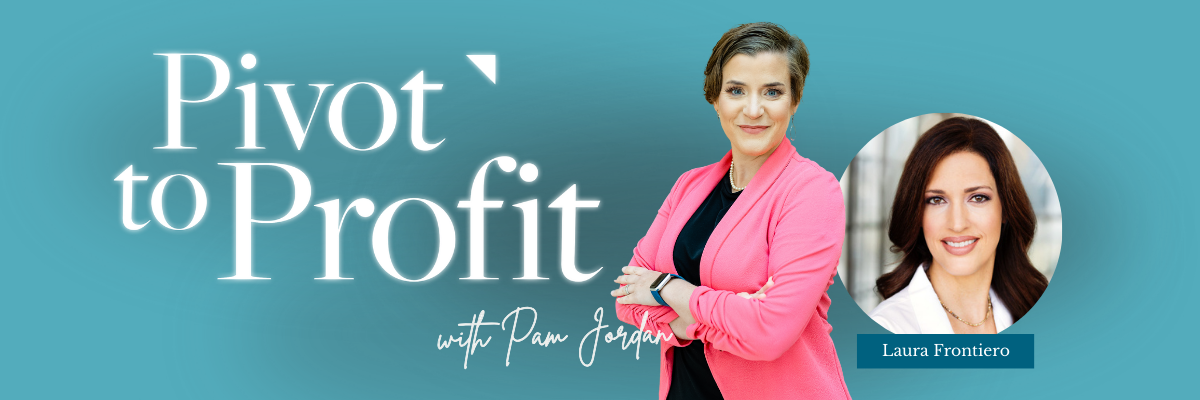
On a recent episode of Pivot to Profit, Pam Jordan sat down with Laura Frontiero, founder and CEO of Bio Radiant Health—an Inc. 500 company recognized as one of the fastest-growing private companies in America. With over 25 years in healthcare, Laura has transitioned from corporate nurse practitioner to seven-figure entrepreneur, helping midlife professionals restore their health so their bodies can “keep up with their ambition.”
Building a Business with Intention—and Numbers
Laura began her career as a registered nurse before becoming a nurse practitioner, spending 21 years in corporate medicine. But after discovering the power of functional medicine and the gut microbiome, she launched a side business in 2018 focused on weight loss and root-cause healing.
Within a year, her “side gig” generated approximately $75,000. As demand grew, so did her revenue—eventually reaching $250,000–$300,000 annually while she was still working full time.
The turning point came when an outside financial advisor reviewed her numbers and presented a clear choice: stay small or go all in. Laura made the bold decision to walk away from a secure job—and even left a seven-figure pension behind. Within a year of committing fully to her business, she scaled to seven figures.
Her advice to entrepreneurs: know your numbers. Financial clarity creates confident decisions.
Why Midlife Health Is a Business Strategy
Now 53, Laura focuses on helping professionals ages 40–65 navigate what she calls the “Midlife Energy Crisis.” As entrepreneurs and executives juggle businesses, teenagers, aging parents, and mounting responsibilities, their energy often declines.
Laura teaches that common midlife symptoms—brain fog, poor sleep, weight gain, low energy—aren’t just “normal aging.” Instead, they often stem from:
Chronic stress and unresolved trauma
Toxic overload
Hidden infections
Nutrient deficiencies
By addressing these root causes, her clients frequently report sharper focus, sustained energy, and renewed confidence to grow their businesses.
As one client shared, “Now my body can keep up with my ambition.”
Scaling Smart and Planning the Exit
Today, Laura tracks everything in her company—from revenue and profit margins to marketing metrics—reviewing trends monthly with her financial team. She credits this discipline for continued growth.
Looking ahead, she’s building her next venture with an exit strategy in mind—proof that successful entrepreneurs evolve from operator to strategic CEO.
For founders listening to Pivot to Profit, the message was clear: your health and your financial clarity are two of your most powerful business assets.
EPISODE TRANSCRIPT
Pam Jordan (00:02)
Hello and welcome to today's episode of Pivot to Profit, where we talk all things business, money, marketing, and today we're talking about your health, because as a business founder, if you're not taking care of your health as well, you will have a very short run as a successful entrepreneur. So my amazing guest today is Laura Frontiero. How are you?
Laura Frontiero (00:25)
Hi, it is so good to be here, Pam. Thank you so much for having me.
Pam Jordan (00:28)
Awesome. So let me officially introduce you. Laura is the founder and CEO of Bio Radiant Health, an Inc 500 company recognized as one of the fastest growing private companies in America. With over 25 years in healthcare, she's led thousands of midlife clients through high impact group programs that help them decode their lab results, uncover root causes, connect the dots between symptoms and reclaim their health without dependence on traditional or
alternative medical systems. That's so amazing. I'm so excited and I'm blessed and honored to have met you in person and spent time with you recently at an event. So super excited to share all your wisdom. But before we dive in, hey listener, if you're a business owner who needs help understanding your finances better, where you're getting surprise tax bills, you don't know where your money's going, payroll is stressful, and you're not building wealth from your business, we would love to help you at Pivot Business Group. Just go to pamjordan.com.
and connect with my team. All right, Laura, are you ready to jump in?
Laura Frontiero (01:32)
I am,
I don't have any idea what you're asking me, so this is gonna be fun. Everybody knows this is gonna be straight off the cuff right now, so we'll see what happens. Yeah.
Pam Jordan (01:36)
know he's gonna be great.
Let's go. It's so much better that way. ⁓
So first is, what did you want to be when you grew up?
Laura Frontiero (01:46)
my gosh. Okay. So from the time I was three years old, I knew I wanted to be in healthcare. And actually the funny thing is when I got to college and I looked at all the prerequisites, so I decided to become a registered nurse. That was the first part of my journey in college. ⁓ and I got to college and I looked at the
prerequisites and all the science I had to take and I tried to talk myself out of it. So this was back in the days when you actually had a course catalog. Do remember they were like a little phone book for the university you were attending. So I sat down in my dorm room one day and I read the course catalog cover to cover. I read every single major. I read every single prerequisite. I read every single thing I had to do. And at the end of the day, I was freaking stuck. I had to be in health care and not one single other major called to me. So there I was, but I
Pam Jordan (02:12)
For sure. Yeah.
Laura Frontiero (02:34)
from a very young age. I always, always said I was going into nursing.
Pam Jordan (02:38)
Okay, I love the passion. So what was young Laura taught about money? From your parents, society? Was money good? Was money bad? Tell me the story.
Laura Frontiero (02:48)
gosh, okay. you know, money was, my parents never made lack of money an issue, but they definitely taught me that it was important to earn it. They definitely- taught me that it took dedication and work ethic to make money. And even in times when we were down economically,
we wouldn't have known it as children because our parents just created a safe space for us. But definitely I knew money didn't grow on trees. mean, definitely I knew that I was definitely groomed to go to college, work really hard, ⁓ earn a living. I was also taught by my mother to definitely always be able.
to support yourself and be able to support anybody else who comes along. In other words, if my husband's job was ever lost or if I ⁓ got divorced or if anything happened that I would be able to take care of myself. That was so ingrained in me from the time I was young.
Pam Jordan (03:58)
Yeah, no, I love it. I love it. And what I find is I asked this question because it's a very defining question of entrepreneurs and their journey. And so the entrepreneurs that have limiting beliefs, I find it takes them longer to get to success. And the entrepreneurs that were in an environment where money was okay to talk about and it was you earn it and you can go get it. People have a different journey. So it's quite fun to ask that question.
Laura Frontiero (04:19)
Yeah.
And there was always enough, right? So there was always enough to do all the things that we wanted to do as a family. And never did I feel like there was never any scarcity or scare tactic around money. And I really am thankful to my parents for that. They taught me to work hard for it, but they also didn't make me scared of it. And we didn't live in scarcity, even when things were rough. So that was a blessing.
Pam Jordan (04:47)
Yeah, it's a really healthy baseline. love it. So healthcare from a young age and you actually are a nurse practitioner. So tell us about the early career when Laura got out of college and now we're a nurse practitioner. What did that look like? Were you like noses, ears, emergency room, urgent care? Like what were we playing in?
Laura Frontiero (05:00)
Well...
Yeah.
Yeah. So Laura got out of college, ⁓ and went straight in to work as a registered nurse first. So nurse practitioner came a moment later, but not much later. So what happened was I got done with college. was like, my gosh, thank goodness that has done that. It's the hardest thing I ever did. I'm never going back to college. No way, no how I am done. And I went in as a new grad into the hospital system and I worked in medical surgical nursing, which is like where you learn your practice. That is where.
you like sink or swim. It is gnarly. is like everybody wants to get out of medsurg. It's a hard place to be. I then I went into telemetry oncology and pre-intensive care. ⁓ And it only took me one year in that space to realize I don't want to do this the rest of my life. In fact,
I want to be more in charge of a bit of a controlling person, control freak, right? A bit of a perfectionist. And I remember working as an RN and taking care of my patients each day and not being able to write the orders. Like I would go to the doctors and say, could you write this, this, and this order for my patient? And I realized I couldn't do that for the next...
you know, 30 years, I wanted to write the orders. So I went back to school after I said I'd never do it. I went back to school and became a nurse practitioner so I could write my own orders. That was basically it.
Pam Jordan (06:28)
I love it solving problems just as all good entrepreneurs do.
Laura Frontiero (06:32)
Yeah, yeah, it was a thing. Yeah, I definitely I didn't know at the time that I was made for entrepreneurship. I went on to have a 21 year career as a nurse practitioner working in big corporate medicine. ⁓ I worked for one of the largest ⁓ medical organizations in the country, if not the largest. And I started my side gig, my business, my entrepreneurial journey started about 15 years into my nurse practitioner practice.
but I didn't exit it until six years later after I started the journey.
Pam Jordan (07:09)
Okay, so tell us about those early days of being a nurse practitioner by day and then the side gig was at the coaching. What did that look like and how did you know? Because a lot of nurse practitioner hours aren't awesome.
Laura Frontiero (07:18)
Yeah.
Well,
I mean I worked like a like a nine-to-five job, right? But what wasn't awesome is I couldn't have every single holiday vacation off. I couldn't have You know, I missed a lot of my daughters Growing up. I wasn't the field trip mom. My dad my husband was the field trip dad I was kind of the missing in action mom that worked all the time and I would show up for teacher meetings and ⁓
things in the evening, like an open house or something. And the other mom's like, that's Bella's mom. She does have a mom. So kind of I missed my child's life. That was the bummer because you're in these hard hours, know, these these business hours, these clinic hours. I couldn't, you know, I'm stacked with a schedule of patients all day long. You got to get that covered and get time off. And it's a whole thing. So, yeah, that was tough. But.
Pam Jordan (08:03)
Fixed hours, yeah.
Laura Frontiero (08:14)
About 15 years into my nurse practitioner career, I learned about the gut microbiome. And -once you see it, you can't unsee it. Once you see that Western medicine is missing a huge component of helping people restore their health, heal, and achieve longevity and achieve high energy all day, great brain function all day, fantastic digestive, good sleep. I mean, we're not really good at that in the Western space. And so I learned about the gut microbiome. And then I just wanted to learn
Pam Jordan (08:19)
Okay.
Laura Frontiero (08:44)
more more and more about that. ⁓
Like I said, once you learn it, can't unlearn it, you can't unsee it. And I couldn't ⁓ give to my patients what I was learning about natural medicine and functional medicine in the Western medicine space. So I decided I'm just going to start like a little coaching gig on the side where I can share this with people and take care of people. So my very first business was actually a weight loss coaching business that was that were the principles that I was using were around repairing the gut microbiome.
and that that being one of the foundational pieces that people cannot lose weight. So I started that and that was in 2018. I think I earned my first dollar in as an entrepreneur. It was so funny because I'm such a control freak and I'm such a perfectionist. Before I like put out that first landing page and had somebody enter their credit card, I went, oh my gosh, I have a nurse practitioner license to protect. What do I do? So I immediately hired an attorney and they're like, girl, you need a corporation.
Pam Jordan (09:28)
of it.
Laura Frontiero (09:46)
You need not LLC. You don't need an LLC. You need an S-Corp or a C-Corp. so I immediately started an S-Corp. And then I put my first dollar into it. I did it the right way. I was always thinking, how do I protect this? Because I got a license to lose. So I quickly realized after about a year that I really hate weight loss coaching. I don't want to do that.
Pam Jordan (09:46)
Yes.
Yeah, you need that wall.
Good job.
Right.
Okay.
Laura Frontiero (10:14)
So that was business number one. It was wildly successful. It was a fun little side gig. think in that first year, I probably sold, I want to say, gosh, I think I've around $75,000 or something in weight loss coaching-
Pam Jordan (10:27)
That's a really decent side gag, Laura. Like,
not bad.
Laura Frontiero (10:30)
It
wasn't bad. It wasn't bad at all. You know, I did have a little bit of cost in my business. had a VA. It was me and a VA. That VA still works with me to this day. It's really important to hire good people from the get go. I boy, did I ever find a gem. And she's still here. She's just expanded with me as my business grows. But ⁓ yeah, so that was the first thing that I did and realized that's how I want to do the rest of my life. So here's the message or here's the pearl of wisdom. You can pivot.
Pam Jordan (10:43)
Agreed.
Laura Frontiero (10:59)
You can change your mind- You can shift what you're doing. Yeah.
Pam Jordan (11:00)
There you go.
So 21
years as an active nurse practitioner in a medical field, five, six years doing weight loss and you realize, I don't like it. What was the next pivot?
Laura Frontiero (11:14)
Yeah, so after the first year, I realized I didn't like weight loss. So then I realized I don't want to be a weight loss coach. I actually want to be more nitty gritty and get underneath ⁓ the root causes of why people have low energy, why they have brain fog, why their digestive system doesn't work, why they can't sleep, ⁓ all of these things that kind of disrupt us in midlife. So I realized the midlife.
person is my person. That's the person I want to help. And so then I went and I took all these courses on how to interpret functional labs. You know, I'm really familiar with lab tests. That's my world in Western medicine. So it was a very natural fit for me to actually study and learn functional medicine. And so I wanted to incorporate lab testing into my processes and protocols. So then I kind of pivoted away from weight loss to
energy, how do we fix our energy crisis in midlife? How do we get our brain functioning better? And by the way, once we fix that ⁓ as a collateral, you're also going to fix your digestion and your sleep because it's all the same problems that are causing- all of this. So that's where I pivoted and that's where I've stayed for the last ⁓ like seven years or so. That is what I have been growing is helping people in midlife to solve those problems that are holding them back.
Pam Jordan (12:17)
It's all connected.
Laura Frontiero (12:32)
You know, a client said to me once, after working through this with you and fixing my gut microbiome and detoxing, my body can keep up with my ambition. That became my tagline. A client literally said that to me. It's on my website. We help you so your body can keep up with your ambition. That is where I found my true love of what I want to do. And then I guess that to wrap up that story and put a bow on it, I did actually retire from the Western medicine space in...
Pam Jordan (12:46)
I love it.
Laura Frontiero (13:00)
three years ago, three years ago in November, I walked out of that space and never looked back. It was the best decision ever. So I just went fully into my business.
Pam Jordan (13:03)
Redress.
I love it. So what was the financial moment where you were like, you know what, this is where my heart is and the numbers are backing it. It's time to go.
Laura Frontiero (13:23)
This is a big moment and this is a really lean in moment for your audience to hear this, because I'm going to tell them something that would scare the crap out of most people and I did it anyway. And it was about the financials. So I mentioned that I worked for the same organization for 21 years. This organization also gave me a pension. Nobody has a pension anymore, but I had a pension, including a 401k. both because I retired early.
meaning not at age 55, I retired at age 51. or 52. No, sorry. I retired at age 49 and I had to wait until 55 to actually gain my whole pension. I had to leave a million dollars of my pension on the table. I walked away from a million dollars of my pension. And I remember sitting down with my husband and saying, OK, I want to do this. I want to step fully into my own business and I want to walk away from my
career and he said to me, hun, only thing I care about is when I die that you are taken care of. So if you think that your business can achieve that, then walk away.
Pam Jordan (14:39)
So wonderful.
Laura Frontiero (14:40)
mic drop, right? Most husbands would be in scarcity. Wait, wait, wait. You carry the Cadillac insurance. You've got the pension. You've got the guaranteed work. My husband is an entrepreneur. He owns a landscape construction business. He does not have guaranteed work. When there's a recession, he has no work. And we've seen this throughout our life. And most men would be in scarcity around this. Like, wait, wait, wait, wait. You've got like this thing here. Why would you ever walk away from it? Money scarcity is a big thing. He did not. He said, go for it if you think you can do it. So what had
happened in my business that was kind of the catalyst to making this decision was we had had a very successful launch of one of my programs and I was doing one-on-one work at the time. You ordered a lab test from me, I got on a call with you one-on-one for 30 minutes, reviewed your lab results, wrote you a protocol, supported you. Well, I sold so many of them that my ability to fulfill them was
too far out. So anybody that knows anything about business and entrepreneurship, ⁓ in order to keep your people engaged and enrolled in what you're doing, you need to give them fast service, fast results, and quick results, quick win. And it was taking me three months to get to these people because I had this clinic job that I was in and I didn't have enough time in the day to fulfill what I had sold. And so at this point,
Pam Jordan (15:51)
Quick results, TV.
Laura Frontiero (16:08)
I had to make a decision and at the time, is now the person who is now the COO and the chief business strategist of my company is a good friend of mine. And she was talking to me one day and said, Laura, I'd really like to look at your financials and see what's going on here and really help you make a decision if you're going to stay here or you're going to move away from your job and moves directly into your business. And so she opened the books and looked at everything and she said, you have two decisions here.
keep this as a hobby and never grow it any bigger than you have right now. At the moment that I did this, I think I was bringing in around $250,000- $300,000 a year in sales.
And that was way more than my nurse practitioner job, right? So I was bringing that in and she said, you will never be able to grow this to a seven figure company if you stay in your job. So you need to make a decision. Either you stay small like this and keep working your butt off and not be able to fulfill all these in a timely manner and lose momentum with your clients. Or you step away from this job.
that has this big pension and all this protection and insurance, health insurance, everything attached to it, and you go for it. And she had this discussion with me and she was like, basically, like, can we cuss on this podcast? Shit or get off the pot? Like, you need to make a decision here. ⁓ And so I thought about it for...
Pam Jordan (17:28)
Absolutely, go ahead. Yeah.
Laura Frontiero (17:37)
about 0.5 seconds and had that discussion- with my husband and I put in my notice, my two week notice and left. And the next year we scaled to seven figures. It was incredible.
Pam Jordan (17:47)
There you go.
That was your burn the ships moment of your friend being like, what are you?
Laura Frontiero (17:53)
Burn the ship down. But here's
the thing. couldn't. Here's my piece of advice for your listeners. I couldn't make the decision without outside counsel. I needed somebody to look at the financials. That is not my primary language. I am a fantastic health care provider. I am amazing in my zone of genius. But the financial piece, it's kind of cryptic and foreign to me. I can see the money coming in. I can see the money going out. I can understand a basic profit and loss.
But the long term vision of what can happen when you compound what you're doing and put your time into it. I needed somebody to actually reveal that and show that to me. That was critical for my ability to feel safe to exit.
Pam Jordan (18:39)
Absolutely, and it's understanding those numbers. I believe numbers tell a story and understanding what that story is can help you make those decisions and feel empowered because to your point Laura, so many entrepreneurs are head down in their business doing what they're amazing at, bringing impact to their clients, providing a service or a product, but then they don't pay attention to their numbers and they're completely missing opportunities. And so you needed that outside financial counsel to say, look girl, you're gonna be stuck at 250 from here on out or
You can burn the ships, go all in, and scale this to multi-seven figures. And just having the understanding of the numbers and what they were saying is what it took for you to be able to make that jump.
Laura Frontiero (19:19)
It is a hundred percent what it took. I never would have done it without the numbers and understanding the numbers and seeing what was possible. And also I will say trusting in myself. If I could do it once, I could do it again and again and again and again. Like it wasn't dumb luck that so many people purchased this coaching program from me. It was because we were providing a high quality product. We were
⁓ full of integrity, our messaging landed with people, they wanted what we were offering. And why wouldn't that happen again and again? And a lot of people just operate from scarcity and fear around that. Like, it was just a one-off. what if I don't achieve it again and everything crashes and burns? So it's that trust in yourself that if you did it once, you can absolutely do it again. Absolutely. It was no accident. And knowing the numbers. If I didn't know the numbers, if I wasn't able to see the trajectory of what I could create, I never would have left.
And I would have been stuck in that cycle of corporate medicine, dying a slow death, not being fulfilled and happy with what I was doing in my life. And now I am very happy and fulfilled with what I'm doing.
Pam Jordan (20:21)
Thank
I love
it. to your point of if you've done it once, you can do it again. But I find this the second time's easier because we've learned, right? And so all the lessons that we had to pay or the tuition that we paid the first round, we completely bypass the second round. So the second time around is much easier than the first.
Laura Frontiero (20:35)
Yeah.
It is so much easier. I think we forget that, just there are. So in our book, I mean, we tell our team all the time, we don't have mistakes. We have learning opportunities and nobody on our team gets chastised and degraded ⁓ for making a mistake. look at what could we have done better to prevent the mistake from happening and how, you know, how is, how am I?
responsible for not giving you what you needed to do your job better so that we could prevent the mistake. And then moving forward, how do we shift from that? Because if you hire well, people want to excel and do a good job. If people are lazy, get rid of them right away. Everybody on our team is ⁓ very ⁓ they are very proud to work for a company that does such good work in the world and they want to be a part of it and they want to do a good job and they want to be fulfilled at the end of the day. So I know that when we make mistakes,
It's just a learning experience. It's just something to learn so we can do it better next time.
Pam Jordan (21:44)
Absolutely. And having a team bought into your
vision is huge. And those mistakes are part of learning. I had a mentor that said, if you're not making mistakes, you're not trying hard enough. And that was just so helpful for me in my early entrepreneurial journey to realize, ⁓ well, I'm trying really hard. So there we go. That mistake was proof that I'm doing what I'm supposed to.
Laura Frontiero (21:53)
for sure. Yeah.
Yes. And
how about this? If you're not making mistakes, you're playing small. And that means you're not giving your full talent to the world. You are just staying in this little safe box. And boy, at the end of your life, do you want to say that I played it safe or do you want to say I took all the risk and made huge impact in the world and now I have a legacy to leave behind? That's what I want.
Pam Jordan (22:31)
Let's go. I love it. now you're years into having your business, you have one-on-one, you've got group coaching, you've got amazing supplements, but financials are a thing. So how have you evolved as the CEO of this business when it comes to numbers? Like what's important to you? What are you tracking? Yes, that's the right answer, Laura. Thank you.
Laura Frontiero (22:51)
my gosh, we track everything. So,
so, ⁓ yes. So I have a fantastic team and.
our monthly financials. look at them at the end of every month. We're looking at what's our top line revenue, what was our cogs, what was our profit here, what we look at numbers for every single thing we can measure. And we're looking for trends. We're looking to see what worked, what didn't work. I mean, that's just on the financials. We're looking at, you know, numbers on our webinars, numbers on our emails, how many are opened, how many are clicked, how many are getting sent to spam. I mean, we're looking at numbers on our webinars.
How many are showing up? When did they drop off? What did I say in my webinar that made people leave or stay? Because we're watching the numbers. Like you need to track everything. And people on my team are responsible for also giving me numbers. Every single week I am in touch with how many refunds did we get requested? Were there any disputes? How many sales did we make? How much revenue did we make in supplements?
month versus last month versus the year before in the same month. What were we doing in that month the previous year that shifted what we're making this year? So we're not just comparing month to month. We're comparing what were we doing the previous year during the same time frame. And so you can't here's what I have to say. You cannot improve your business if you aren't in relationship with the numbers and they're not scary. They really aren't. They even if I can understand them and learn them. But the thing
Pam Jordan (24:12)
Love it.
Laura Frontiero (24:28)
is that I have a team around me who helps me decipher it. So we sit down together, look at the giant spreadsheets of all of the numbers, the huge, the extended profit and loss sheet for every month. And people who are smarter than me in that help me understand it. Okay, you see it. And they find trends that I can't see.
they will see something. I'm like, ⁓ yeah, that's spreadsheet magic, right? You see that in the numbers, I would have missed that. what I've said to entrepreneurs is stay in your lane of genius, stay in your zone, stay in your lane and allow somebody else to stay in their lane because...
My financial team has really helped me save a lot of money and find out where I'm losing and need to make pivots and shift. So you get to save more at the end of the year and you get to grow and learn where you're making mistakes and what you can do better or where you're making learning opportunities, right? We just established there are no mistakes.
Pam Jordan (25:25)
Right. No,
I love all of that. That is magical. That's exactly my heart. I love it. So let's talk about midlife and why you chose that. Because you have an amazing tool called the Midlife Energy Crisis Report. So why did you choose this spot?
And then tell us about the energy report and what can we be doing as entrepreneurs? Because every entrepreneur that I know that's successful is operating at a very high level. Lazy people do not scale to multi-seven figure businesses. But that is also hard because we're working really hard to do that. So tell us about midlife and the energy crisis.
Laura Frontiero (26:03)
Well, your health is one of the most critical pieces to being able to perform at the level that I do, that Pam does, to be able to put your genius out in the world to help more people. And if your health crashes in the middle of all of this, your business does too. Because for most businesses, when the owner or the founder is not operating,
Everything else crumbles because they're usually leading the charge. would say most businesses are founder led, right? They're not set up for it to keep going when the founder can't. So I'm one of these. So I am the primary facilitator and teacher in all of my programs. If my health and I have a team of coaches and all kinds of customer support, but at the end of the day, our communities are showing up to see me. They want me to teach them. And so I am an example.
of my health, I must practice what I preach. So midlife, I mean I'm in midlife, I'm 53 years old, this is natural for me to teach midlife health. ⁓ You know, people are having families later and later, so people in midlife are having children. So midlife is actually defined, I mean brace yourselves everybody, if you're 40 you're in midlife. I just want to say, I'm sorry to say.
Pam Jordan (27:24)
Cheers. Cheers.
Laura Frontiero (27:26)
you are in midlife if you are 40 you are you are no longer a youngster and our body does physiologically shift and the other piece I really want to land here is that we also accumulate as we age a higher toxic load more chronic stressors and traumas in our life either big traumas or small traumas we accumulate more exposures to infections
and our cell turnover is slower. So it's a perfect recipe for energy to plummet, for brain to not be as sharp, for ⁓ pain in your joints and your body to set in. I mean, you name it, it's midlife. And then people start to live with it, Pam. They're like, well, I thought that was just normal in midlife. It's so funny when we get people, yeah, it's just normal. When we get people feeling better, they're like, ⁓
Pam Jordan (28:05)
It's just normal, brain flogs are usual. Yeah.
Laura Frontiero (28:11)
I thought that this was how I was supposed to feel at age 55 or however old they are. So I think I also believe that, you know, people in midlife and we're probably one of the largest populations on the planet right now, age 40 to 65 or so is the largest group. And we have a lot of good things to do in the world and a lot of people depend on us. So in our age group, most of us have children and parents who need us. So you've got teenagers, maybe through
I mean, I have a 21 year old, she fully needs me. She's fully dependent on her parents right now to survive. She's in college and she needs us. And then we have our aging parents who are starting to need us. Like I've taken over my father's full finances at this point. our parents need us, our kids need us, and we're sandwiched in the middle of all this. And we've never needed to expend more energy and brain power than ever before. So that's why.
Pam Jordan (29:06)
And it's leaving so quickly.
Laura Frontiero (29:08)
That's why
midlife. That's why I'm passionate about that. ⁓ And so the underlying reason that we the root cause of why all this happens to us is, a lot of people focus on, maybe it's my hormones, maybe it's my adrenals, maybe it's my thyroid, it's metabolic. Yes, all of that is important. But what's driving that? What's underneath? Why did your hormones go wacky? Why did your thyroid go wacky? Why did your adrenals go wacky? And that's where I come in. So in that midlife energy crisis report, I'm talking about the foundational reasons why these
things
go sideways and then we feel lousy. So infections, toxins, nutrient deficiencies, stress and trauma, those are kind of the four buckets of everything. And if you solve those four things, then you can feel more energetic. You can feel more creative. You can feel like your brain is running like it did when you were 25. Do you remember the days, Pam, when you could keep a list in your brain of all the things you had to do and you never had to write anything down? I remember that in my 20s.
like why do people keep lists? Like can't they just remember this stuff? Well you can get back to that. You can get back to being able to remember like that. I just want to tell people there's hope. You can't have energy that lasts all day. You can wake up feeling rested. You can sleep soundly. You can have all those things again. So that's why. I mean I'm just passionate about this group.
Pam Jordan (30:12)
What's wrong with them? I'm fine.
Okay, so share with us a story of a business owner who you've recently worked with who's gone through your programs and the transformation they experienced.
Laura Frontiero (30:39)
my gosh, we get so many. So we attract a whole wide range. We attract moms in their 40s with teenage kids. We do have people all the way down to their 20s in our programs, but that's not our most prevalent. Most people are more ⁓ motivated to do something about their health as they get older. And then we get people all the way up to their 90s. So then there's this group in the middle. And primarily we get a lot of corporate
you know, C-suite women and men, get a lot of health practitioners, there's a lot of doctors in my programs, doctors and health practitioners who are trying to figure this out. And so what we hear repeatedly over and over again from professionals that are in our programs are things like, you know, I had...
Pam Jordan (31:16)
I it.
Laura Frontiero (31:28)
I had put my nonprofit to the side. thought I would never get it off the ground. And now I have the energy and the brain power to do it. Or I didn't go for the promotion at work. So for the people who are employed by others, didn't want to take on anything new. I was afraid I didn't trust myself or my brain. But now I feel like I can do that again. And then we have people that had just kind of shut down their businesses, like not taking new clients, not expanding, not growing.
not trying to learn how to grow. And the feedback that we get is, I feel like I can grow now. I feel like I'm motivated. I feel like I can actually go to the next level and trust that my body will keep up with my ambition, right? That's what I said earlier. This is what people tell us. So this is consistently what we hear from people across the board, whether they're working for someone else at a high level or they're in management or they're running their own businesses.
Pam Jordan (32:14)
Yeah.
I love it. I love it. This is amazing, Laura. So what is next for you? What's on the horizon?
Laura Frontiero (32:33)
More of the same. ⁓ So here's what I'm really good at. I'm really good at finding a direction and staying the course and just keep building on that lateral. What I don't do is get...
Pam Jordan (32:47)
I it.
Laura Frontiero (32:49)
distracted with, shiny object over here, maybe I'll do that. Ooh, shiny object over here, maybe I'll do that. Ooh. So I know, and everything that I do is very calculated and strategic to bring in top line revenue. And then the other piece that I'm working on is exit strategy. So how do I create a business where I can bring in others to teach what I teach and to do what I do so that I can exit? And I think one of the things that entrepreneurs need to think about is
Start with the exit in mind. So I'm building another company right now where that's what I'm doing I'm starting with the exit in mind. I did not do that when I started my first company all it just focused on Because I am the brand I am the brand and so so that is the piece I'm working on now with the second company is strategically me not being the brand and So that I can sell that so you build a company to sell it build a company to sell it, right? This is where a lot of brand new entrepreneurs can't even think that far like what I can't
Pam Jordan (33:27)
because you were the brand.
Yeah.
Laura Frontiero (33:47)
I just want to bring in my first $100,000. Like, I can't think about selling this thing for 50 million. Like, what? don't... Yeah, but that's where I'm at now. So next level of how do I build something to sell? That's my next trick.
Pam Jordan (34:02)
Well,
I can't wait to see it, Laura. This has been fantastic. Thank you so much for sharing your story with us. Where can people connect with you?
Laura Frontiero (34:10)
well, I am the brand. So laurafrontero.com. My name is spelled like the great frontier with the O on the end. And we'll give you a link so people can get that midlife energy crisis report. You can drop that in your show notes and send us a message there. I'm also on Instagram at laura.frontero. You can find me.
Pam Jordan (34:29)
Awesome. ThiS
has been fantastic. Thank you so much. So that's all for today's show. Make sure that if you need help understanding your financials and you've got a pivotal decision to make that you have that financial clarity of what are my choices? What can I do? Just go to pamjordan.com. We would love to help you. And remember, it's not what you make that matters. It's what you keep.