Unlocking Business Success: Emotional Conversion Strategies with Talia Wolf
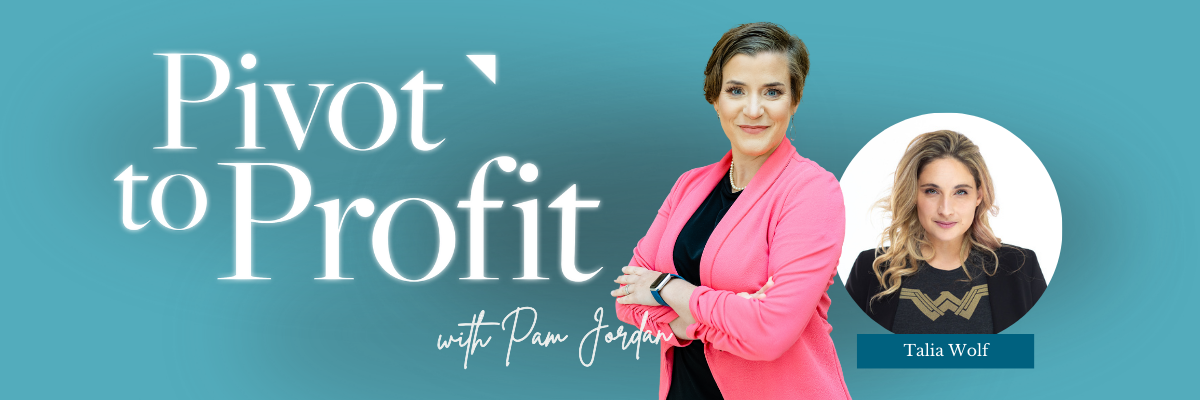
In a powerful episode of Pivot to Profit, Pam Jordan sits down with conversion optimization expert Talia Wolf to explore how businesses can turn website traffic into meaningful revenue. As the founder of GetUplift and creator of the Emotional Targeting Framework, Talia shares why understanding customer psychology is the missing link in most marketing strategies—and how emotional marketing drives sustainable growth.
From Corporate Marketing to Conversion Optimization Leader
Talia Wolf’s entrepreneurial journey began long before she launched her agency. Raised by a father in business, she developed an early interest in entrepreneurship. Although she initially pursued traditional marketing roles within large organizations, her curiosity about what truly drives revenue led her into the emerging field of conversion optimization.
Rather than focusing solely on website design tweaks or surface-level improvements, Talia began experimenting with messaging, offers, and user experience to understand what actually motivates customers to take action. That experimentation became the foundation of her expertise.
Her turning point came when she decided to launch GetUplift while pregnant—realizing it was “now or never.” She introduced her Emotional Targeting Framework through an online course, generating $60,000 in her first launch and validating her innovative approach to conversion rate optimization.
What Is Conversion Optimization—Really?
During the conversation, Talia explains that driving traffic is only half the battle. The real challenge lies in converting visitors into leads and paying customers. Conversion optimization is about improving the entire customer journey—from first impression to final decision.
She emphasizes:
Clear and compelling messaging
Strong value propositions
Storytelling that resonates
Deep understanding of customer emotions
Rather than copying competitors or relying solely on “best practices,” Talia encourages business owners to uncover what makes their brand unique and communicate it in a way that connects emotionally.
Why Emotional Marketing Drives Results
Talia’s Emotional Targeting Framework blends psychology and marketing to uncover what customers truly feel—fears, desires, hesitations, and motivations. By addressing these emotions directly, businesses can build trust, strengthen customer engagement, and increase conversion rates.
Her advice for entrepreneurs is clear: test consistently, listen to customer feedback, and remain flexible. Sustainable business growth doesn’t come from chasing trends—it comes from building genuine connections.
This episode of Pivot to Profit highlights a critical truth: when businesses focus on emotional marketing and customer experience optimization, they don’t just improve conversions—they create lasting loyalty and long-term success.
EPISODE TRANSCRIPT
Pam Jordan (00:02.19)
Hello and welcome to today's episode of Pivot to Profit, where we talk all things business. Sometimes it's money, sometimes it's marketing, sometimes it's people. Today's expert is Talia Wolf, and I cannot wait for this conversation. How are you today?
Talia Wolf (00:17.044)
I'm good, thank you so much for having me, I'm excited about this.
Pam Jordan (00:20.298)
This is going to be a fun one business owners. let me officially introduce you. Talia Wolf is the conversion optimization expert, author and founder of GetUplift, the optimization agency brands like Aptitude, Bitly and Strata turn to when they want to drive more leads, sales and conversions with a meaningful customer first methodology. Talia was recently recognized as one of the most influential experts in the field of
conversion optimization and has been invited to keynote on hundreds of stages. So, so excited for you to share your wisdom with us. Before we dive in, hey, listener, if you are a business owner and you need help understanding your finances better, you're not sure where your money is, overpaying on taxes, we would love to help you. Just go to pamjordan.com and book a call with my team. All right, Talia, it's time to dive in. Are you ready? Very serious question.
Talia Wolf (01:14.441)
Yes.
Pam Jordan (01:18.018)
What did you wanna be when you grew up? What was like 10 year old Talia's big dream?
Talia Wolf (01:23.498)
That is such a good question.
What did I want to be? I think I've always wanted to be a businesswoman. I know that sounds kind of weird, but when I think about like what I used to play when I was a kid, I would spend time with my cousins and my siblings and every single time I'd be the businesswoman, I'd have a briefcase and I would pretend to like go and sit at a table and kind of work at my computer and do all sorts of stuff. So I guess I've always wanted to be, I mean, that's so boring as a kid.
like no I want to be a firefighter or a police officer no I wanted to be in business yeah
Pam Jordan (02:04.014)
I love it and like ditto, ditto. So Talia, what were you taught about money as a child? Was money good, bad? Do you want it? tell us that story.
Talia Wolf (02:07.497)
you
Talia Wolf (02:16.242)
Well, I think similar to quite a lot of millennials, not a lot was taught about money, if that makes sense. Like my dad has run his own business forever. So it was always a conversation and he was a businessman. He is a businessman to this day. So I've watched him build a business from scratch and he's built a few of those. And I think a lot of my...
thoughts and perceptions about money come from him. But then on the other hand, my mum was a stay at home mum, which was very different. And I grew up thinking various things about that. I don't know, it wasn't a positive or negative conversation. But it was definitely a big part of the conversation at home, I guess.
Pam Jordan (03:03.416)
Yeah. Yeah, well, as an entrepreneurial father, I'm pretty sure every day wasn't great. So you had to be able to see the ups and downs of that journey.
Talia Wolf (03:10.771)
Yeah.
Yeah, and it's definitely what paved my way, right?
I was daddy's little girl. So all I wanted to do was be like him and he was so impressive. He is still impressive, which is insane. 67, still running three companies. So yeah, I think just growing up, it was a no brainer. It was like, this is what I will eventually do. It took me way too long to get to it for various reasons, but it was definitely a thing of like, yes, this is a hard thing, but this is what you do in life. And all of us were all, four siblings.
all but one run our own businesses. So, take it away.
Pam Jordan (03:51.096)
I love that. So let's go back to your journey to becoming an entrepreneur, because you've worked for large companies and then started your own business. So tell us in the early years, big corporate, big businesses, market optimization, all that. Tell us a little bit of that.
Talia Wolf (04:09.076)
Well, I actually started out agency life. my first role, I started actually an internship in a social media company and it quite...
I'm going to say very fast, I actually got hired and then within about a year I was managing my own team and then ended up like really managing most of the clients. I was director of clients there. So it was kind of a very quick way in for me. I just loved working agency side, loved all the client stuff and I would work with very big brands, mostly on social media and paid ads. I then started working at a few startups and
and I mostly did marketing and stuff like that. And then I did start learning about conversion optimization. When I got into it, there was really maybe only two companies in the world who did conversion optimization, and I didn't even know that what I was doing was conversion optimization. I just thought, well, we're doing all this stuff for our clients. Let's figure out if we're actually making them money, because back in the day, all people cared about was just traffic.
started playing around with, okay, what if I change this? What if I change this headline? What if I change this call to action button? And I started saying, hey, this has an impact on revenue. This has an impact on leads. This is so cool.
And I did end up working and doing this kind of work for different brands in-house and ultimately started my own agency, conversion optimization agency focused on psychology and emotional marketing and stuff like that. So was really kind of, I got started not really knowing what I was doing, but eventually built my own framework. And it was also quite fun because I...
Talia Wolf (05:58.764)
did what I think a lot of companies now do, which is kind of kind of by showing everyone. So what I would do is just write a weekly case study on our blog and just like, hey, here's what we tested this week and what didn't work and what did. And that quickly got us a lot of readers and subscribers. So that was cool.
Pam Jordan (06:18.932)
it. So let's go like fifth grade level. How do you describe conversion optimization? Because everyone is like, people might be confused what that means, but as all business owners, is supremely important that we understand because it directly affects our bank account. So fifth grade level, help us understand.
Talia Wolf (06:40.476)
Absolutely. Okay, you're driving traffic to your website and you are hopefully getting as much traffic as possible and most of us that's what we focus on. The problem is you've got people coming to your website and let's say you've got a thousand people a day. That's great.
what are they doing on your website? If you've got a thousand people coming to your website and only 20 people are signing up for your email or 20 people are signing up for your trial or contacting you or buying something from you, my job in conversion optimization is to optimize your website. That means design, copy, UX, everything, the messaging, the story, in order to turn those 20 people into 100. And conversion optimization is all about optimizing
your website, your email and the entire customer journey so that more people land on your website.
understand what you're selling to them, can clearly see that you've built something for them and buy from you. And that's really the role. So you don't actually touch traffic or think about social media. It's more about how do you communicate a really good story and how do you turn everything on your website into something that convinces more people to buy whatever you're selling.
Pam Jordan (07:59.79)
I love it. I love that. That's a great definition. Cause a lot of times people try to get so complicated in their websites and then you're like, okay, well I don't even know where to push. what button, what do you want me to do? Like I've hit some websites and it's like, there's five options. what do you, like, do you want my DNA? Like what's going on here? So I love that this is what you do because it's so imperative because social media is one thing, but most social media points to your
Talia Wolf (08:20.33)
Yep.
Pam Jordan (08:29.036)
business website and if your website is confusing and people don't know where to go, they're going to go somewhere else and they're going to leave. So when you started get uplift, what was the moment that was like, I have to do this. I can't do it for anyone else. Why did you decide to hang up a sign that said Talia is now the business owner?
Talia Wolf (08:35.718)
Absolutely.
Talia Wolf (08:48.768)
As I mentioned, I think I started way too late. I first started, went to work in a conversion optimization agency with two other people. So was their business and I run the agency. I was running it, but it wasn't mine. And I was, I think for lack of a better word, scared. I was scared to go on my own. I knew that I knew I'd eventually arrive there, but I never actually...
took the leap and funnily enough I found out that I was pregnant with my first kid and
This is kind of psychological, right? But I grew up in a house where my mum was a stay-at-home mum and my dad was the businessman who provided. So for me, when I found out that I was pregnant, it was like, well, it's now or never, because once I have kids, I will never be able to work. So kind of twisted, right?
Pam Jordan (09:47.821)
I love it.
Talia Wolf (09:48.746)
But that was, and I was like, okay, it's now or never. I was six months pregnant and I quit my job and I was like, I'm just gonna do it. And if it works, it works. And if it doesn't, I'll figure it out as I go. And it sounds insane because most people, when they get pregnant, they're like, I have to stay in this cushy job. Just like, everything going. But for me, was like, everything in my life is about to change. I cannot allow myself to miss this opportunity. So I took the next.
three and a half months to build my own business, create a course, because I was like, well, I can't really offer any services right now. So I'll do, I'll take everything that I've done and I'll turn it into a course and I'll sell that. And when I'm back for MATLEAVE, I'll start, you know, bringing in clients. So for me, that was, I guess, the moment, if that makes sense.
Pam Jordan (10:39.438)
Love it. Let's go moms. Yes. I'm a mom of three so I get it. So tell me about early on with GetUplift a financial win where you're like, this might actually work.
Talia Wolf (10:54.548)
Great question. think for me, the first win was actually not to do with the services, but the course. So I finished working at this agency and I built this methodology called the emotional targeting framework. was and still is very different to everything in my industry because conversion optimization is very data oriented. It's very numbers oriented. And most of the people out there talk about it in a very technical way and very
kind of develop a first way. But I developed a framework all about psychology and emotion and how to create a website that really appeals to people's emotions and connects with users. And because I was a little worried about taking on clients when I'm almost seven months pregnant at this point, I thought I'll turn it into a course and then hopefully I will be able to make some money and when I get back, I can do something.
And I think what was really interesting is that, well, first I wanted to write a book and then my friend Joanna Wiebe, who is phenomenal and incredible, said to me, no, no, no, don't do a book, do the course, make some money. And my first launch ever, I think made 60K maybe? And I was blown away. And I was like, holy moly. And this was like in three months and I was blown away. But more than the money,
Pam Jordan (12:14.242)
Let's go, congrats! Huge!
Talia Wolf (12:24.276)
The fact that people really wanted to learn this, understood how important this methodology is and wanted to add that to their arsenal was like, okay, this is going to work. I can do this. And I did the first cohort and I learned from my students and I was like, okay, let's go. Now I can create my entire service around this framework and I know that people are gonna love it. And that for me, it wasn't even the biggest financial thing.
just the fact that okay people want this people care about this and it matters and I can do it.
Pam Jordan (13:01.646)
Absolutely. And I'm sure launches now, you know, are much more significant, but there's something about that first one that's just that win of like, I can do it. Like I remember six months into my business, I'd made more money than I ever had. And I looked at my bank and I'm like, I can be an entrepreneur. It's okay. Like, you know, like, like you just need that win.
Talia Wolf (13:11.104)
Yeah.
Talia Wolf (13:18.238)
Yeah, because you need that. You need that win to believe in yourself. It's not even financial at that point. It's just like, okay, people like want what I have in my brain and it's not just this fictional thing that like I live in this thing and I think it's important, but everyone around you acknowledges it. Yeah, like this actually matters.
Pam Jordan (13:38.678)
Exactly. So let's dive into your framework, the emotional targeting framework. Help us understand what that is. Cause you say it's not how other conversion optimization services do it. So like break it down for us.
Talia Wolf (13:53.45)
So conversion optimization, you know what, let me take it back.
If you're sitting in front of your website right now and we're talking about all sorts of people like, know that you're driving traffic and you're looking at your homepage and you know that something's not working or the pricing page or you know that it's the lead for, something's not working and you set out to go optimize it. And what you usually do is you'll Google it or you'll ask ChatGPT or Gemini, hey, what are best practices for a homepage? And it will tell you to only have one call to action. Don't have five call to action buttons
That's confusing. And, you know, don't write too much copy and do this and do that. And there's entire recommendations out there telling you what to do in order to optimize your website. And it's very tactical. It's change this element, remove a form field, add an exit pop-up, all sorts of things that are very technical.
but that actually doesn't work very well. It is good if you're just getting started and you don't have a website and you're like, okay, I just need to make sure that just best practices are okay and that I don't have a carousel that's moving every one second or that I have five buttons. But when you actually want to really scale and grow in conversions, that's not gonna get you anywhere. Testing a blue button versus a red button means nothing to no one.
And then what usually happens is you'll say, okay, this isn't working for me. I've tried everything. I'm going to go over to my competitor and see what they're doing. And then you start copying your competitors because you think they know what they're doing, but they're copying from you and everyone looks the same. And it's just like this insane kind of hamster wheel because then you're like, well, I'll get some tools. I'll buy software. I'll use AI. Okay. So nothing happens. And the go-to
Talia Wolf (15:41.82)
A-B testing and CRO methodology is really changing elements on the page. The emotional targeting methodology focuses on something very different. My goal is to help people buy from you. And if I want to help my clients get more buyers, I need to understand how their customers make buying decisions.
So my entire methodology is based on understanding how do people make buying decisions, what goes on in their brains. And I went back to my Batcave and I realized that, and this isn't me, this is psychologists and neuroscientists and researchers for decades have proven that every single decision that we make in life is based on emotion.
There's always emotion involved, whether if we're buying something that's just for us, if it's a B2B decision.
There's always emotion involved. So I understood that if I can decode those emotions, if I can understand how people are feeling before coming to a website, what their challenges are, what they're worried about, what concerns them, what's keeping them up at night. And then if I can also understand how they want to feel, what do they want to feel about themselves or what do they want other people to think about them, then I can create a customer journey that really speaks to them in a way that they land- on it and they see themselves and they can
with it on an emotional level. And this is so much more important because as I mentioned before with competitors, everyone at the end of the day has more or less the same offer. We have similar pricing, we have similar features, similar integrations. And when a prospect comes to your website and they're evaluating you, they're evaluating other products or other services, and they're gonna ask themselves, okay, but what's the difference?
Talia Wolf (17:29.8)
If your pricing is the same and it's in my budget, okay, great, you're wonderful at what you do, but it's very similar to others. How do you make a decision? That decision is emotional. People are scanning your wayy to find those connectors to say, yes, they're speaking to me, they understand me, they know the problems that I'm facing. So everything in our framework is designed to understand how your particular prospect make buying decisions. And once we understand that,
It actually opens everything for us because when we then look at a homepage and we've done all the research, like we've interviewed people, we've done surveys, we've done social listening, which we can get into, but once we've done all that, then we'll look at their website and it will be so much easier to identify why people aren't converting because now I can see, my gosh, I'm talking about things people don't care about or I'm highlighting stories people don't connect with. The social proof makes no sense.
no one cares about this stuff. So it's a lot easier to find the misalignment and what's not working and then you can optimize. So that's kind of the framework. The framework is about testing for that.
Pam Jordan (18:40.942)
I love it because it doesn't come down to what color to make the button. It's does the messaging hit an emotion that your client wants? Because buying decisions are emotional and there's a whole lot of psychology about it, but you either want to stop pain or bring joy. And most people in the business world, if you're B2B, they don't like in my world, they don't come to me because things are great. They come to me because they have a big tax bill or they don't know their numbers or they can't make payroll. Like that's why people come to me. And so it's not about what
color scheme of my website, it's does my website say that? And so I love that you're using the emotion, which really is a big difference, because a lot of other people I talk to, they're like, well, just make sure, your brand, does it match your brand guide and are the fonts right? And I'm like, I don't think that's gonna make someone click on a button.
Talia Wolf (19:24.222)
Yeah.
Yeah, I agree. And I think also, like, if you take it even deeper, like when someone comes for financial help for their business, it's not that just they can't make payroll. It's more than that. It's the feeling that they have as a person, like...
Am I even good as a business person? Like, can I even lead my company? Maybe I'm not good at this. Maybe they have imposter syndrome. There's so many different things that are behind that they will never admit. Maybe they're not even admitting to themselves, but you actually have to hit on those notes and you have to be able to identify beyond that. And we've seen that with many service providers that even when you're providing a marketing service, so if you're a doctor, if you're providing financial services or consulting.
all of that, there's always emotion below that, there's always something about self-belief or how I want other people to think about me and that really matters and if you're not addressing that then you're losing conversions.
Pam Jordan (20:23.182)
Absolutely, I love it. Can you give us a recent case study of how you've taken someone through your emotional targeting framework and really helped them hit the emotions that their clients were looking for?
Talia Wolf (20:35.794)
Yeah, so we work with all industries really. So we do a lot of B2C, we do a lot of B2B, SaaS, tech, service providers, publishers.
I actually just published a new case study for a moving company in the US. And I guess I'll talk about that because it's quite interesting. We've noticed in the past year and a half that all of their competitors are very aggressively talking about pricing. This is a moving company, so they help you move across state lines in the states. And...
All their competitors are talking about get the best quote, get special pricing, call now and get a best offer. And I think when you're in such a competitive landscape, it feels less risky to just follow suit and just say, yep, let's just talk about pricing. Now, of course, pricing matters when you're moving, because you don't want to pay too much.
But when we did our research and a lot of it was actually digging into Reddit conversations and hundreds and hundreds of conversations on Reddit about moving across states, what we discovered is that most people, and when we looked at our clients' reviews and testimonials, was all about the fact that they wanted all of their lives to arrive in one safe piece on the other side. So like everything is being packed into this truck right now and they...
want to make sure that when it arrives on the other side, it's all taken care of. This is their life and they want to talk to someone that they feel trust, that is going to be polite, is going to be kind, is going to treat them nicely and their stuff. So what we did is we actually doubled down on that message, like white glove service, premium moving services that focus on making sure that your entire life will arrive in one piece and well and will take care of you and all of your stuff. And of course,
Talia Wolf (22:33.012)
we did mention pricing, but pricing is the surface level concern. It's something where you're just saying, okay, like, I just want to make sure it's in the bracket like everyone else. It's not double the price. But the real concern_ is, my God, will my stuff arrive intact? And by doing that on their landing pages, we increased their conversions by 14 % in one test. It is huge, especially for this size of a company. So it's incredible to see that
Pam Jordan (22:54.958)
That's huge.
Talia Wolf (23:02.892)
when you do focus on not just the surface level stuff, like so many people will say, well, it's easy to use, or you've saved me time, or it's cheap. But that surface level, what you're trying to understand is why these things matter. So by literally focusing on what they really care about, that got us the conversions that we needed.
Pam Jordan (23:26.702)
I it. I love it. And that's, it's true. Cause as a consumer price is a thing, but I'll pay a little bit more for the, the peace of mind that all of my stuff is going to show up in one piece where I need it to show up. So it makes total sense that you are not worrying about necessarily the color of the button or the font or those things, or where things are on the website. But it's the messaging of, you want to make sure all your stuff gets to your new house in one piece? Yes. That's, that's the stress. So I love it.
Talia Wolf (23:55.678)
Yes, exactly.
Pam Jordan (23:57.07)
So, Talia, you are the owner of this business. So let's talk numbers. So how has understanding financials played a role for you? Because your title is the chief optimist, which is great, or chief optimizer, but you can't just ignore the numbers of the business while you're the chief optimizer. You also have to look at your PLN on Valchia. So as the CEO, founder of the business, how have the business financials of your business played a role for you?
Talia Wolf (24:26.398)
Yeah, and a very important role. think starting out, didn't pay much attention to it. It was more about, I'm building this business. It'll be fine. I can make, you know, my own salary. I think within...
three years into the business is where the pivot happened, mostly because we had an insane year and I was like, we can make that much money, okay. And then you have to start hiring people and building teams and thinking about, how big do you want this to be? And for me, I mean, I've never...
sat in like a business school and I've never literally gone through spreadsheets. So that was a journey for me to learn like, what does an actual P &L look like? And how do I calculate stuff like profitability and percentage of work? And so it's not something that comes easy to me at all. And with ADHD, it's even worse. But I can say that I've spent
the many years now working on it and training my brain to do that because it really, really matters. And it's something that I put a lot of emphasis on. I will say that the first few years where it wasn't a big thing for me, actually, I think that was a good direction for me personally, not putting too much pressure on like, okay, this needs to be a seven figure business, but it was more about, okay,
I need to build this, I need to love what I'm doing, I need to enjoy it, I need to see that this actually can happen. But now, obviously for years now, it's been about, okay, setting financial goals even if they feel very scary.
Talia Wolf (26:13.916)
and saying, okay, this is where we're going. And also including everyone in the agency, like, okay, listen, this is what we're going for, and this is what we're trying to do, and here's how our numbers look like. And just really being frank about, okay, we might not hit this, but we're gonna try. And that helped.
Pam Jordan (26:33.71)
But yeah, I strongly encourage our clients to be transparent with their team as much as they feel comfortable about the numbers. Because if you're sitting down with your team and be like, hey, this is what we did last year. This is our big goal for this year. And you can rally the team to that vision. Your chances of success are much higher if people understand why we're trying to do that and what the number is. And then they're more bought in. They're like, hey, we're going to grow because it's fun. Like that's not inspiring for people.
Talia Wolf (27:00.32)
Absolutely. And I think it's a lot about getting everyone on the same team. Like, know, look, this is how much the profit is. This is how much the revenue is. Like, all this stuff, like, literally just opening it up and saying, like, you are part of this team and we're all in this together.
So for me, yeah, I try to be as transparent as possible and also my entire team is women. that, yeah, for me is also kind of a mission. Like we're all working on this together and we're all looking at the numbers and we're being, you know, having those hard conversations about what makes sense and what doesn't and how big do we wanna be and yeah, so I like it.
Pam Jordan (27:38.776)
So what are some key metrics that you look at as the chief optimizer, but also the founder of the business, look at at a weekly or monthly basis that really tip the scale for your business?
Talia Wolf (27:50.122)
For us, mostly I'm looking at our profitability, which has been kind of a hard change for me over the past few years. Because you want to think of like, I want to think about the...
can't really think about it, right? But that is a big thing for me. I'm not looking at it weekly. I'm definitely looking at it more quarterly because you can also plan things and say, okay, the next few months are gonna be less profitable and I know that I'm building this team over here, so that's gonna need more time and over here, this is gonna need more time. So I am looking at that. I'm looking at success rate with clients, like how long they stay with us. That also_ affects our profitability
because obviously getting new clients is very hard, but keeping them means that you're retaining that revenue. And they're happy and we're happy and you know that that's gonna keep coming in. So those are kind of the biggest metrics I'm looking at.
Pam Jordan (28:50.136)
So what is on the horizon for you? What's next for you?
Talia Wolf (28:54.334)
Well, good question. I finally hired a COO, which was a big, I know I've had like VAs and PMs and also, but COO is now a thing, which is so phenomenal and lovely to have. Thank you. Growing the team. I recently published my first book, which I'm also really excited about. So.
Pam Jordan (29:09.688)
Congrats.
Pam Jordan (29:18.062)
Congrats.
Talia Wolf (29:19.168)
Thank you. So yeah, lot of my, year, like this year is really focused on training and building the team. We are growing, which is fun. But also just making sure that we are really systemizing everything and that there's a repeatable process for every single thing. Because I think when you get started, like I started in 2016. So this was quite a long, like 10 years ago. So
The first few years of a business, you're kind of just like winging it and you're taking on all sorts of clients and you're like, okay, yeah, I'll do this for this and I'll do this for that. But the past, I would say like five years have been really like, okay, systemizing everything and this year is even more like how do we use the right tools and how do we make sure that everyone's bought into everything. So that's mostly where we're going.
Pam Jordan (30:12.238)
I love it. And there's so much brilliance in that because honestly, transparently, all of us, when we start as entrepreneurs, we just say yes to everything because it's money, right? And it's like, yeah, I can solve that. I can solve that. can solve that. And so it really is as you're scaling and wanting to level up your business, it really does come down to the systems and the people and the processes so that it allows you to scale. everything, you as the founder, aren't the bottleneck and so that other people can do the things that you do.
Talia Wolf (30:21.192)
Yeah.
Pam Jordan (30:41.076)
use your framework and help clients and bring value. And it's not just relying on you, but you can only do that if you have systems and processes.
Talia Wolf (30:48.276)
Yeah, and I will also say that I think as a service provider, one of the biggest advantages and privileges that I have now, because I've set up my business that way, is that I can say no to red flags. And I think in the past, when I didn't have it all systemized, and I didn't know really, you know, how profitable we were, or what we were doing, then you'd say yes to everything, even if you had a hunch that maybe this isn't a good fit.
And the past, yeah, like four or five years, I can say, yeah, like this is a potential incredible, like big financial project, but it's gonna kill the team. And I'm not interested in these, in this. And I can say no, or I can fire a client. I was just talking about this on a previous call. We can fire a client that's paying us a lot of money because you're treating us poorly or you're not doing what we need and you're a bad client for us.
And I think that that is also like very empowering to be able to say no to the wrong things.
Pam Jordan (31:50.894)
Absolutely. I have a mentor that in 2025 told me, he said, it's more important what you say no to than what you say yes to. And as you scale your business, that becomes so true because when you first start out, you say yes to everything. But as you're growing and scaling, it is important the clients that you say no to, the team members that you say no to, the projects that you say no to, because that allows you the bandwidth to optimize your business along while you're scaling.
Talia Wolf (32:19.219)
Absolutely.
Pam Jordan (32:20.686)
All right, Talia, this has been amazing. Thank you so much for sharing your profit story with us. Where can people connect with you?
Talia Wolf (32:26.922)
Well, you can connect with me on LinkedIn, obviously, which is number one place. You can also connect with me on YouTube, or on my website, getuplift.co, where you can get the book or read more. There's so much free content that you can download and read.
Pam Jordan (32:43.502)
Awesome, so generous of you. Thank you so much for your time. That's all for today's episode. Look, listener, if you're ready to understand your numbers, increase your profit, reduce your taxes, just go to pamjordan.com to connect with my team. And remember, it's not what you make that matters, it's what you keep.