From Profit to Performance: Ron Gourley on Innovation, Inflammation, and Entrepreneurial Health
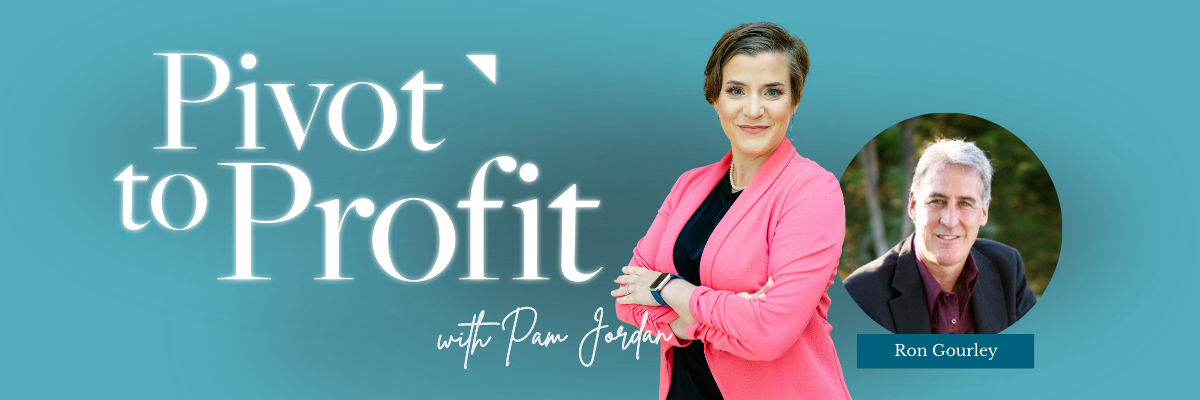
On this episode of the Pivot to Profit podcast, Pam Jordan sits down with serial entrepreneur and product innovator Ron Gourley to explore the intersection of business growth, financial wisdom, and personal health. With more than 35 years of experience building brands in cosmetics, OTC supplements, agriculture, and regenerative medicine, Ron shares hard-earned lessons from both corporate America and the startup trenches.
Lessons in Money and Entrepreneurship
Raised by a naval officer father, Ron learned early that money must be earned—and respected. If he wanted something, he had to work for it. If he borrowed money, he paid it back with interest. That foundation shaped his approach to business and investing.
After beginning his career in corporate sales and marketing for Fortune 10 companies, Ron pivoted into entrepreneurship, launching his first company around breakthrough antimicrobial and wound-healing technology. While the science was ahead of its time, he learned a painful but powerful lesson: be careful whose money you take.
Ron emphasizes that not all capital is created equal. Entrepreneurs should look for financial partners who:
Understand the industry
Offer flexibility during growth and scale
Bring relationship capital, not just cash
Align with the long-term vision
“Money for the sake of money,” he explains, “rarely ends in a good partnership.”
Why Inflammation Is the Root of So Many Problems
Much of Ron’s current work focuses on fighting inflammation—the root driver behind many chronic illnesses, including diabetes, cognitive decline, and metabolic disease.
Through his company, Supernatural, he has developed innovative, highly bioavailable formulations built around:
Curcumin – a powerful anti-inflammatory compound
Advanced nanotechnology delivery systems for cellular absorption
Therapro Clay – a unique U.S.-sourced clay that helps bind and remove toxins
His Body Control product supports individuals—especially those on GLP-1 weight loss medications—by helping manage toxin release and inflammatory responses during fat loss. His Brain Boost formula targets brain fog, focus, and cognitive performance without stimulants or crashes.
Health Is the Ultimate Wealth
Throughout the conversation, Pam and Ron return to a central truth: financial success means little if your health can’t support it.
Entrepreneurs often sacrifice sleep, nutrition, and recovery in pursuit of profit. But as Ron notes, optimizing cognitive function, reducing inflammation, and supporting regenerative health aren’t luxuries—they’re performance tools.
The takeaway from this episode is clear:
Understanding your numbers builds financial freedom. Protecting your health ensures you can enjoy it.
For entrepreneurs focused on both profit and performance, this episode is a powerful reminder that long-term success requires alignment between business strategy and personal well-being.
EPISODE TRANSCRIPT
0:00
Welcome to the Pivot to Profit podcast, where we believe that understanding your numbers is the key to freedom of time and money.
Because at the end of the day, it's really not about what you make, it's about what you keep.
So each week, we're going to bring you real stories from real entrepreneurs who have faced the challenges of growing a business.
0:22
We'll also dive into how numbers have helped and sometimes hurt them, and gaining clarity over their finances has unlocked new levels of profit and freedom.
Hello and welcome to today's episode of Pivot to Profit, where we talk all things entrepreneurship money and today we have an amazing expert, Ron Gourley with us How are you Ron?
0:45
I'm.
Doing great Pam, thanks for having me.
Absolutely, I'm so pumped to have this conversation.
So Ron is an entrepreneurial visionary who has a unique talent for spotting impactful products that deserve a place to shine.
He researches and has an unparalleled understanding of the science and the why behind his products returning powerful performance driven results.
1:09
Ron has spent the past 35 years building brands and companies in the cosmetic products, OTC drug supplements and agricultural.
He brings a broad base of knowledge and relationship capital to multiple strategic channels.
1:25
Ron, I cannot wait to dive in.
So my first question is, what did you want to be when you grew up?
Oh well, I originally wanted to be a chemical engineer and I started hanging around chemical engineers and decided I didn't want to be a chemical engineer.
So had a lot of chemistry and physics in my background and I really wanted to get into business.
1:44
I mean, in terms of corporations, work for 2 Fortune 10 companies coming out of school, consumer products.
And then I just kind of realized that I really wanted to get into the other side of business, which is to grow companies and look at technologies.
And so I really spun off and kind of took a new career path and started looking into some really breakthrough technologies and work with those.
2:06
I love it.
What was young Ron taught about money?
My dad was a naval officer and so in my house, if you want any money, you had to borrow it and you had to pay back with interest.
So I mean, everything from, you know, when I wanted my first bike, I had to earn half the money in my household.
2:21
It was, there was nothing.
It was given, it was you had to earn it all the way through.
And then basically at that point in time, you know, early on after college, I mean, I started pretty young in the getting a house and getting into the whole side of, you know, what we consider the American Dream.
2:38
And so my respect for money came really from my father who taught us a lot about, you know, how to handle money and the fact that, you know, savings was a big part of our, our world.
So you 10% of everything had to go into a savings account no matter what.
So that's how my early years were, were really driven by that.
2:55
Wow, that's great lessons.
A lot of people that I had talked to do not have a good foundation that savings is important and that you've got to work for what what you have and your dad charged you interest.
That's amazing.
He did.
It was, you know, I had my first car.
I had to earn the money for my first car.
3:11
And if it broke and I didn't have the money, I'd borrow it.
And then I'd have to pay it back with interest, which, you know, taught me a lot about making sure that I had savings.
Because you had money doesn't mean you can go and spend it.
So I learned pretty young that you had to put some stuff away for the future.
So what did you end up going to college for?
3:28
Was it chemical engineering?
No, I started, I started taking a lot of science, but I ended up taking my degrees are basically in finance and marketing.
OK.
So definitely business focus.
So we get out of college.
And how does your entrepreneurial story start, Ron?
Because you've been involved in many companies over the years, but where did like Ron LLC start?
3:48
Yes.
So it was at the time I was actually working for a large corporation in a national sales and marketing position, traveling pretty much three cities a week, every week.
And it was, you know, it got to a point where it's like, OK, this is not what I want to do.
Was at a convention, basically a show and was introduced to a technology that was an active antimicrobial technology.
4:09
So a skin care product that we were just ahead of our time at that point.
But that product you could put on your hands, it would last about 6 hours, a little bit longer, but actually put vitamins back into the skin and it would not wash off.
It was electrostatically locked to the skin, but the molecules behind that is where I really got started.
4:27
So the molecular structure of that was a new invention, patented at that time.
It was patent pending, became patented, and those molecules were called tertiary amide acid hydrate molecules.
And that got me to the Rockefeller Institute where I got to meet Doctor Joshua Lederberg, who's a Nobel laureate.
4:43
He was chairman emeritus at the time of the Rockefeller.
He chaired the science council for my first company and it was centered around those molecular structures.
Josh was a guy.
If he look him up, he's a guy that really was a father of genetics.
He discovered what's called a plasmid, which is how RNA and DNA are transferred in when bacteria go into recombination.
5:04
So once they learn and then they share, and they continue to learn and share.
So he discovered that he's the father of AI.
Everybody's on this right now.
So meeting him was probably one of the biggest things that influenced me in terms of my desire to continue to look for solutions in other markets and other technologies.
5:22
And so those molecules to cut.
So this was way ahead of our time, but we built emulsion.
So think about like a thick cream if you will, but with inherently unstable compounds.
And so we basically sat, the goal of it was to try to figure out how to make an emulsion that mirrored subcutaneous tissue in the human body.
5:41
So if you look at all the vitamins, your minerals, amino acids, fatty acids, antioxidants, complex carbohydrates, glycerols, etcetera, they spent about two years looking at electron microscopes because you're looking at frequencies.
So everything has a frequency.
We're trying to figure out.
It wasn't just any vitamin, it was the vitamins at how the closest we could guess.
6:00
No one really knows the exact frequencies off subcutaneous tissue, and you put those all into an emulsion, put it into the wound, pack it in, and we healed from the bone up.
So you could have exposed bone.
We usually had granulation in 36 hours, and you can regrow that tissue from the bone up and heal it about 72 to 78 days.
6:21
But what it was is kind of called bio kinetics.
In other words, we put everything the body needed and let the body sort it out.
It could take what it wanted when it needed it in the different phases.
And that technology was fantastic.
And one of the lessons I learned was, you know, be very careful whose money you take, you know, when you're building a company, because the guys that came in destroyed the, the company and they, they literally drove that technology into it's sitting right now.
6:46
I mean, it's, it's my patents are up on it.
I mean, go get it.
But to build it, you have to have a little bit of knowledge of face chemistry and different things.
So that technology was absolutely to me, brilliant.
So we could stop tissue from breaking down.
We could rebuild tissue from the bone up.
We could keep it active, protected from bacteria while simultaneously healing it.
7:06
And so all of those technologies, that was my first jump out of corporate America.
And so taking those, building those products, branding those, taking them into the market, dealing with the regulatory environment around that.
And we manufactured our own products.
So you know, we had a lab.
So there's a whole bunch of stuff that goes into dealing with the the FDA and all that, the regulatory stuff.
7:27
So there's a big experience leaving corporate America and finding out that, you know, corporations, you know, when the when the artwork's on the walls, you know, that kind of stuff that you know, you just take for granted.
It's there when you have to go build it.
That's a that's a completely different lesson in business to to take it from the ground up.
7:44
So, but that was really what I started with was that and you know, you look at COVID and what happened, had that technology still been around?
Right now it is light years ahead of putting alcohol on your hands.
And I share this with people all the time.
It's seconds, right?
8:00
So you put this alcohol on your hands.
If you ever read the studies where they say 99.99 kill, whatever, they put 5 milliliters, they took 5 milliliters of alcohol on their hands, which is a lot.
And you sit there and wipe it, and then they're telling you that's the kill.
But remember, you killed all the good and all the bad and you killed it all.
8:17
So that means the next thing you touch, you have no defense system on your skin.
Nothing.
You destroyed it.
So the natural bacteria, that's part of who we are that helps protect us, You've destroyed that as well.
It's now gone.
So the ability.
Yeah.
So the ability for us to COVID when everybody's walking around wearing masks, I'm sorry, but it was it was the silliest thing. 90.
8:37
So if you take 96% of all cross contamination is right here.
It's your it's your hands.
So you touch it, you move it here, a surface doesn't jump up and grab you.
You have to touch the surface.
So the reality is airborne viruses are less than 1 1/2 percent of actually cross contamination.
8:55
And again, it was silly.
The virus is so small.
Wearing those stupid paper masks was not doing anybody any good.
So this was it.
Most people don't realize, you know, when you're touching the outside of that that's actually now transferred onto your hands.
And that that was a big part of what we were teaching in hospitals with C diff and MRSA and all the different things that are cross contaminated in hospitals.
9:16
It's this, this is the big issue.
And you know, it's a shame that it wasn't available and that all hit because it would have saved a lot of people from the sickness just by being actively protected with their skin.
Yeah, no, I hear that.
And then your hands are what how everything is transferred.
9:32
I do want to jump back to a point that you made really quickly and then breeze through.
Is the lesson learned.
There is watch who you take money from.
And I see that so often entrepreneurs when they're growing and scaling and they need, you know, capital investments.
There's a difference between smart money and just money.
9:49
Help us understand warning signs of to know when is it bad money.
I don't want to point fingers.
I call them vulture catalysts that VC when you're looking at money and you're looking at control and corporations.
And so you look at, let's say, the direction, what phase that company is in when you're taking the money.
10:08
So for me, it's, it's, it's the front end money on an entrepreneur on a startup is, is critical that you got to remember it's, you know, who has the technology?
What is the technology?
Who controls those pieces?
How much of it do they want, you know, with regards to the money and then what controls are they putting on it in terms of the flexibility of the corporation?
10:26
So when when you're young, let's say you have a new technology, you've got to be very flexible.
So the money needs to be flexible as well.
So the more controls that they get into the ability for that company to grow quickly and to have the cash that it needs on the front.
That's probably for me, the big part it it's who who is who is really controlling that dollar and what do they want for that money?
10:49
And then realistically, are you going to be able to satisfy a return on that money, if you will?
And that's a big challenge because you know, in the companies and the stuff I've started, you run into all kinds of problems.
You run into situations where you know, you don't anticipate.
It could be a regulatory issue.
11:04
It could be something just with regards to scale up.
And when you're scaling technologies, you need to be, you need to know what you're doing because you know, you can get stuck, you can search and sell you everything's taken off and all of a sudden you can't scale at the rate that you thought you could scale.
So then you end up in a situation where you get cut short.
11:22
In other words, you don't, you can't hit your sales, you can't hit your Rev numbers, you're not going to hit your returns.
So all of those lessons, and it really depends on the projects because I've built different projects at different levels.
And that's probably the big challenge is just making sure that the people you're going to partner with, and here's another one, make sure the people you're partnering with money and understand the business you're in.
11:43
In other words, to me, the best partners are people that understand the industry, They know they've been in it, they have relationship capital, they have they have relationships and other businesses and things that can help drive the, the the company itself.
And so money for the sake of money without that to me usually doesn't end up in a good partnership.
12:01
The partners that I found are the best are the ones that are in the understand the industry that you're in.
So whether I was in agriculture and Otcs, if you're dealing with consumer products or if I'm dealing with direct to consumer models that that are not in store door.
So all of those, the more you have with people with money that understand it, they're easier to deal with because they understand the challenges.
12:21
And when they I don't understand the challenges, then it becomes really difficult for the company to really move.
Yeah, I, I hear you 100%.
And the key there is flexible because when you're first starting out, whether it's a product or service, you just never know what roadblocks you're going to have.
12:38
And if you have someone on your shoulders all the time, show me the numbers, where's my return, where's my money?
And whatever you're trying isn't working.
There's a huge Mitch match.
So they do need to understand your industry, but also be flexible and give you time.
I was speaking to another successful entrepreneur that had a pretty large exit recently.
12:55
And they had private equity money and they did have a partner that was very comfortable with the industry, very flexible using your term.
And they had a pretty sticky situation that they got in.
And if they had not had that level of partner, they would not have succeeded.
The realistic position when you're going into anything like that is something's going to happen.
13:15
I mean, it could be a competitive situation, it could be that the technology that you have somebody comes along and knocks it off or and I've had people steal technology and all of those things become they're very realistic.
So making sure your partner is in the business and understands to me and you know, we've got a project in order to start right now that is really cutting edge in peptides and anti aging.
13:39
And so that is, you know, you're, you're looking at something that again, the scale up.
How do how do we get to the scale?
In this case?
You're talking about something it's got 1000 amino acid chain thousand.
It's called Chlofo.
So Chlofo is a is a peptide that is key to our reversing our aging and slowing it not only way down, but yet actually you got your chronological years and then you got your cellular years.
14:01
So the two of those, so we're, we're working on how do we keep, make sure we keep our cellular life, you know, young and here even though you've got age on this side, but what it does is it really slows it down.
So that chlothoprotein in 1000 amino acids, that's a very, very long peptide chain.
14:18
And so how do you the only way you're going to be successful in doing that is you have to go through a recombinant.
So in other words, you, you take it, you attach it to a host, usually like a non pathogenic E coli and you grow those and then you clip it, you clip it off, but 1000's a lot.
14:36
So if you go into the chain and find the pieces that you need that are critical and use those, which is kind of what we're looking at.
And then once you have that, then you have to be able to scale it up and you have to deliver it.
And so oral delivery now is where everybody's going.
So injectables, the FDA has kind of taken a very hard line on it.
14:53
So now we have to do all that and make it into the marketplace.
And taking that technology and delivering it into the marketplace is at least a year.
It's going to take a simple amount of money to to build that out and then then you go launch it.
15:09
So the book was written, one of the guys I work with the who's just a genius in regenerative medicine.
So he's written the book.
Now we're going to, we got to build the, the technology to support it.
So that's a great example.
And I'm in it right now is like, who is the partner that I'm going to get?
So I need somebody that understands peptides, understands what's going on the regulatory side.
15:27
And then you got to keep that technology.
Once you have it, you got to really keep it private.
That's not something you farm out.
So then you're going to have to have a lab, you know, with the technology control to do it.
So that's a great example.
So right now I'm, I'm looking at that and I'm saying, OK, who is the right?
I've got the right technical partners, right, but now I got to go find the right financial partners to see the vision of what we're going to be doing and the benefit it's going to have for society and people to have that.
15:53
And you got to make it affordable.
That's the other thing.
Otherwise you you can't have the impact that you want.
Yeah, you know, it can't regenerate medicine kind of is a is a wealthy man's game right now, if you if you will.
I mean, it's not, not wrong, but getting that, one of the things I'm really shooting at is how do I make that way more affordable for everybody to get part of regenerative medicine?
16:13
Because just in general, our general health, which is something I always look at it, it needs to be something that's affordable for people.
And yet really good technology isn't that inexpensive when you when building some of the products they just built, not inexpensive.
However, you know, the more I build, the more it sells, the more I can drive that cost down on it.
16:33
But we still built the best product we could build and made it as affordable as I could.
But at the same time, I know that in a year or two I can bring that price back in line just by volume.
And I love bringing the financial side into that because volume does.
16:48
It doesn't solve all problems, but volume does help cover direct cost, cover overhead, ensure profitability consists, stays in place so that you can drop the price down and not lose your margins.
It's, it's all true.
It's nothing like a really nice contract that pays all the bills and then everything else that comes on top of that's, you know, profit, you know, getting that contract that covers all the lights of building, the insurance and everything else that just recently happened.
17:14
And it's something I've been working on on a project.
So once we have that, it was like, OK, everything out was gravy on the top of that.
But getting that first contract and getting the equipment and everything in place, you know, it took it took time.
Yeah.
And having the financial partners that are in alignment and understand your business but are also flexible is what you're saying is the key to those success.
17:35
So one of the businesses that you're working on now is called Supernatural and it has a couple products also partnered with biosoluble curcumin, which involves inflammation.
So that's a whole lot.
So talk to us about the current projects under Supernatural and why your heart for helping people with inflammation is so strong.
17:55
Being that I was in the, let's say the wound care side, right?
So I saw what diabetes does to human beings in a very dramatic way.
So when you have somebody that's going to lose their foot or their leg because of non healing wounds, because of diabetes, I really started focusing on, well, the wound care industry itself.
18:12
That's a that's a long story, but they're really not helping people heal wounds.
What they're really doing is they're making a whole lot of money on a wound and healing wasn't necessarily that what they were looking for.
And today, even though there's we had great technology, there's still that industry is really not where it should be or could be in terms of helping people.
18:29
So I focused on the other side.
Well, diabetes, so you have pre diabetes, diabetes, inflammatory diseases.
I started really looking at, well, how do you stop this to begin with?
How do you keep them?
Don't even get to the wound care center.
I don't want you there.
They might want you there and that's a lot of money for them.
But man, I got to tell you something.
18:45
It's not a place you ever want to be.
So I started looking at and so the inflammatory side, there's curcumin is an amazing molecular structure.
Now it's multiple molecules called curcuminoids.
So curcumin is the name of one of the prominent curcuminoids.
And then there's a series, they say 3, there's actually like 23 actually small molecular structures.
19:06
It's very complex, but it is known as a super anti-inflammatory.
So you look at there's 10s of thousands of studies done on curcumin and I would challenge anybody, put the word curcumin in your browser, put any disease behind it.
Just put a disease behind it.
Look what pops up.
Go to the NIH, put curcumin in the browser and put a disease and look what pops up.
19:25
And the reason why there's so many studies is because inflammation, so a lot of what is inflammatory is caused by something called reactive oxygen species, Ros, you know them as free radicals.
Sometimes we feel that these are these are things that are food, they're in the air, they're in what we drink.
19:43
And you talk about forever chemicals and pee floss, you look at heavy metals, you look at all these things.
And what people understand is all through your life, when you come into contact with these things, your body will take it and attach a fat molecule to it and store it.
So what happens is that will then get released later.
20:00
That goes into your bloodstream through your liver and back.
So people losing weight, which we're going to get to that, they don't realize that one of the reasons you feel really bad when you're going through that is you're, you're releasing a ton of toxins into your system and going back in.
It's going right back in through your organs and into your bloodstream.
20:16
So that became part of my focus, which was, OK, how do we shut down these inflammatory pathways?
How do we basically take care of the toxins?
And so curcumin was one of the pathways and it's very challenging.
Because it's virtually insoluble and we're water, we need to have solubility in terms of getting stuff in.
20:33
So the first challenge was making it, getting it soluble.
I worked with some chemists that we first used a protein.
So we took like a whey protein, isoline, animal protein, tucked the molecule inside of it, and then the body would see the protein pulled across and as it digested it, the curcumin would latch on to basically the bond, the cysteine bond between the amino acids.
20:54
And we could shovel it.
Well, that's good.
Also you're on an animal molecule.
So now I have to put it comes from cheese, you know, whey protein.
So whey protein isolate.
So it's allergic reactions to that.
Plus like by pork bellies because the the market on proteins is it's just like it just jumps around.
21:10
So we ended up going further and worked with a team that took it's called inclusion chemistry, used cyclodextrin.
So big fancy name, there's alpha, beta, gamma, cyclodextrins.
These are like starch molecule.
Think of it that way.
So it's a natural plant based molecule and it's like a molecular cup.
21:28
So you can take these curcumin molecules and nano put them inside there and then you can use that and the body's going to see it pretty much like a sugar.
So it's, it's a, it's a starch molecule.
So now we have a non allergic carrier, something that's used in the food industry.
21:43
It's used in the Pharmaceutical industry widely, basically made a very efficient delivery system.
Same thing.
The body's not seeing the curcumin.
I'm not worried about it.
It's delivered where I want in the body.
So I can get it through to where I want and, and get the body at the at the duodenum, get it, it's small test and get it over and get the results we were looking for.
22:02
So we got the results actually better than we had before.
And then we started looking at what I call is all right.
So that's I have those products, you know, you can, you can look at they're great.
But then I said, OK, well, let's build some really cool products.
So there's a technology we call Terapro clay.
22:18
It's a clay deposit that's in the United States, like 15 years of research at A&M, Texas A&M.
And this particular clay does not interfere with the microbiome and your gut does not interfere with nutrient uptake like these other clays do, does not have a heavy metal or dioxin issue.
22:34
So all the other clays that you see come from saltwater volcanic ash.
This comes from a freshwater volcano that was 20 million years ago in Mississippi.
And so that was a massive water freshwater deposit of the volcanic activity of volcano.
So that particular ash is unique to the world.
22:51
They haven't found another deposit that's like it.
But the really cool thing about it is it adsorbs just a huge amount of toxins in your system.
So 1g of this in your body.
So 500 milligrams is is more than enough for most people, but you can take up to 4 grams a day that it will adsorb heavy metals, it will adsorb molds.
23:12
So Afrotoxins and mycotoxins and ketones and all of these things that are part of that fat that we store that we get rid of or the toxins in our bodies.
So we took that and we combined it over with the curcumin and so that that product is called Body Control and part of the, the, you could take it every day for anything just to protect yourself.
23:32
But part of what we did was we took it because of all the GLPS that are out there and all these people on weight loss.
And I don't, it doesn't matter to me what your weight loss program is.
You are going to burn fat.
And when you burn that fat, what's going to happen is you're going to release those toxins.
The clay grabs the toxins, the curcumin deals with the inflammatory responses.
23:51
So you got two things in one product.
They're doing two different things, but they work in synergy with each other.
And so you have the benefit of protecting your body while you're going through the process of losing your weight.
And so that was the first product and it's out there.
And the the second one is really complex.
24:08
And, and this gets into the cognitive issues and you look at what's going on as we're aging, you look at the population and as we're coming through, you see all this rise in cognitive wider rate cognitive issues.
One of the ones people talk about often is the brain fog, right?
And COVID, thanks to that wonderful little gem, brain fog became a very real effect from that.
24:28
And then it's, it's a lingering effect and you hear people talk about it quite a bit.
Well, so how do you begin dealing with that?
So we took, there's a formulator that I worked with and just brilliant guy.
And I said, look, you know, I had a product called brain Boost, but it wasn't, it didn't have enough of that.
24:44
What I wanted on the cognitive side, it really worked heavily on the immune system.
So what we did was we took he has a patent pending nanotechnology delivery system that we tagged into because Vicon, first of all, getting something in the body is one thing, but getting it into a cell is a completely different thing.
25:02
And through the blood brain barrier that's a different thing.
So making sure that you have a delivery system that has cellular assimilation, not just bioavailable, not just getting it in, but getting into the cell.
So we worked on a product, it's called Brain Boost on, on the supernatural site.
25:18
But when you look at the complexity of it, it really deals with pretty much every aspect of the human brain in terms of of what you're looking for, whether it's memory, whether it's focus, whether it's cognitive repair, then it's cellular level.
So the more you take it, the more it actually enables the brain to repair.
So we're just giving it the things it needs.
25:34
The body does the work.
We're just, we're just giving it the tools, just like I did with wound care, right?
Give it the tools, let the body sort it out.
So that particular product is, it's pretty brilliant.
And it's, it's something there's unlike these other products, they throw caffeine in it.
There's no crash.
25:50
You take it, you feel it pretty quick.
In other words, you get clarity, you get focus in the, the testing that we basically ran through AI models and everything, it said basically what you built, the only thing better than what you built is the methamphetamine.
So literally it's that much clarity.
26:05
And I, the gentleman that's on the film, who I know very well was on Adderall and, you know, he wanted to come off of Adderall.
And when we were in R&D phases with that product, I was giving it to him and he said, he goes, this is the best thing I've ever taken shy of Adderall, but I need to get off of that.
26:25
So in other words, his, his compliment is, hey, this is really good and that's what we are shooting for.
I went after brain fog.
I went after the the cognitive issues on ADD, you know, for clarity and focus and, and those things.
And we're we're really proud of that product.
It's just released it and that so I got more complex.
26:43
So I took what was curcumin, which is a key for anti-inflammatory, you know, in the brain, which is we are shut inflammation of the brain down.
And then we took it, we just started developing it.
And the next product we'll come out with is a super immune system product.
It's a it's a massive just immune boosting product and it'll follow these two products.
27:01
I love your passion, you know, as a young kid wanting to be science and engineer and then going to school for business and then now building all these products to truly better the world.
And as entrepreneurs, we need like, you can't be sick if you're a business founder.
Like there are no sick days for me, right?
27:18
And also we have to be optimizing ourselves and our mental capacity because when you're running multiple businesses, multiple 7 figures, tons of team members operating at that level, you need to to be at the top of your game.
And so having supplements like this to help enhance and make sure that you're optimized because there's things like elderly parents and perimenopause for US women that are coming in hot that are making a lot of us entrepreneurs not optimized the way we need to be.
27:45
Right.
One of the test markets I ran on that product on the brain boost was in the, the airline industry.
And with it started with some flight attendants that have serious issues with brain fog because of the COVID issues.
And the same with the officers, the, the captains and the flights.
28:04
And so I, I had some R&D product, I put it out there and they were like, when can I get this product?
Literally started it in 30 days or 30 days of product.
No brain fog, nothing phenomenal.
And as soon as it stopped, it's like it started, came back and they're like, you know, we need this.
I said well that was R and DI said I'm.
28:21
I'm Yeah.
Yeah, give me, give me a hot minute because that's a, but again, that particular just the feedback from these people like this is what I need This Yeah, this does it.
It doesn't like that.
It's not a you have to build it up.
You take it and you start to feel it right away.
28:37
So those are the challenges.
And I continue to work on redener medicine.
It's kind of a different product.
I'm working with oral peptides.
So as the industry is going away from injectables, we're well down the road of being able to release the first one's going to be a copper peptide and a soluble edible format.
28:56
And that particular technology is done right now.
I'm just, I'm doing some dosing studies and then we'll start to release it.
And the excitement in the industry because people are trying to get to there, but no one had the ability to get the level of the peptide across that we can get across an oral, you know versus an injectable.
29:15
So you want to get a close as you can to an injectable and everybody's sitting at like 30% and we're sitting up at about 90.
That level of, you know, yeah, it takes a while to figure that all out, but that is kind of the next.
I really like regenerative medicine.
I like where we're going.
I like where the technology's moving.
29:31
There's some really great technologies for all of us, everybody on this to really slow down your aging.
I mean, it's just, it's not you're going to live, it's chronological.
So I can make you look really good going through chronological, but it's a cellular.
So you really want to make sure that that cellular activity in your life is, you know, 20 years younger than your than your chronological age.
29:53
Yes, aging well is important.
Yeah, that's, that's all true.
So that's again, the Supernatural product line.
We're really excited about it.
And again, it's, it's we have a discount code for your, your people.
I don't know if you put it up there, but it's pod 26, like podcast POD 2626% off on your, on your initial order.
30:17
So order wisely because that's a, it's a good discount.
So it's ordersupernatural.com.
And if you just, you know, from our perspective, if you do take the time, your financial health is really one thing, but man, you be healthy to enjoy your financial successes.
30:32
And, and I really mean that because I've seen a lot of people in my life who went after the financial success and they really didn't pay attention to their body to to themselves, and they ended up not being able to enjoy what they built.
I definitely don't want PC people have to go through that.
There's definitely answers out there.
30:49
Absolutely.
One of my first clients when I started as a fractional CFO was driving hard on the financial success and unfortunately recently had a very dramatic health event because he was not taking care of his his health.
And when his daughter got married, he wasn't even able to walk her down the aisle because of that health event.
31:09
And you know, you work so hard as entrepreneurs for impact and for wealth building.
And then at the moment where you want to walk your daughter down the aisle, he couldn't even do it because of the health challenge.
And the money didn't matter in that moment, right?
So as entrepreneurs, it's important to understand that you need a strong financial health.
31:27
You need to understand your numbers.
You need to be focusing on your profit and your margins and all those things.
But all at the end of the day, if you're not taking care of your health and your relationships, what's the point?
I agree and I hope everybody heard what you had to say because that was well put from our perspective.
In the next year you see the anti-inflammatory, the new inflammation product and you'll see a new product coming out for pre diabetes and type 2 diabetics, for glucose control.
31:51
No drug we can, we can do that now very effectively.
And using this new nanotechnology delivery system we have, we're going to be able to build some really interesting products around keeping people away from even taking them off of Metformin and moving them back into a healthy lifestyle.
32:09
Most people when they come to Metformin, you got to always remember one thing, you never come, You're always going to go towards diabetes and it's not solving a problem, it's just putting a Band-Aid on something inevitable and you really want to get off of that train.
And so I'm going to be building a product very shortly that is going to allow people to be able to do that.
32:28
Awesome Ron, I love your heart, I love you as a human and I love all the impact you're doing.
I myself have used your products and recommend it often.
So I'm excited to try the new Supernatural products.
So I will use the code and get some myself excited for all you're doing.
Just to follow up with Ron, just go to ordersupernatural.com.
32:46
And if you are needing help with your financial help with your business, just go to pamjordan.com and book a call with my team.
Because remember at the end of the day, it's not what you make, it's what you keep.