From Video to Revenue: Todd Hartley’s Lead Generation Lessons on Pivot to Profit
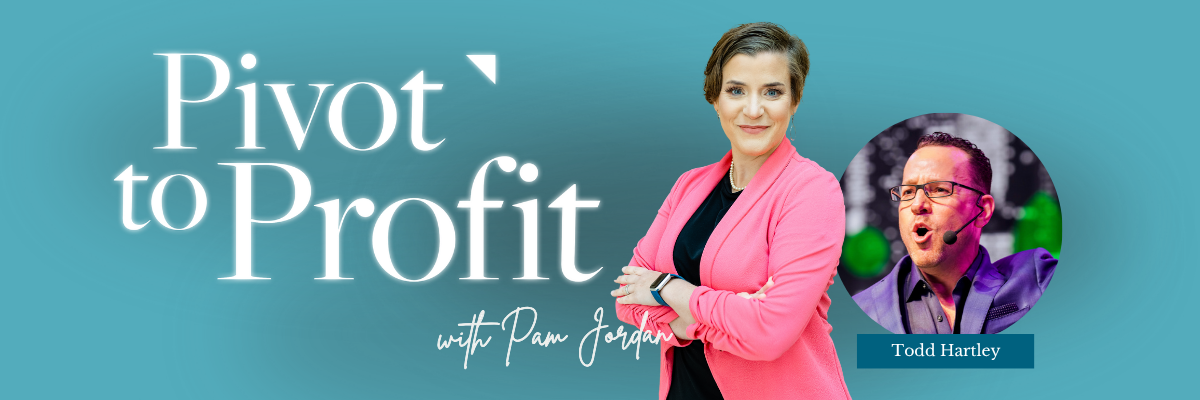
In this episode of Pivot to Profit, host Pam Jordan welcomed Todd Hartley, CEO of WireBuzz, #1 bestselling author, and a recognized expert in lead generation and revenue growth. The conversation blended Todd’s personal story with practical insights that help entrepreneurs turn attention into predictable revenue—without sacrificing profit.
Todd’s early years were marked by struggle and self-doubt. Placed in “slow” classes as a kid, he carried the belief that he wasn’t smart enough—until his grandfather helped reshape his mindset through books, audio learning, and daily encouragement. One name kept coming up in those conversations: Tony Robbins. By age 12, Todd had a clear vision of becoming a motivational speaker on the biggest stages, and he credits that clarity for guiding every decision that followed.
That ambition eventually collided with a rapidly changing digital world. Todd began in radio, then pivoted hard into online content and search optimization in the early days of the internet. By September 22, 2002, his website was on track for 36 million visitors per year with zero ad spend. That success led to a role at iHeart, where he saw early data proving video would become a dominant tool once bandwidth improved. By 2007, he left to build a massive video-based medical encyclopedia—an experience that paved the way for WireBuzz.
Todd shared a defining early-business breakthrough: after 11 months of hearing “no,” he created a simple proposal video to help prospects visualize his strategy. The result was immediate—three “yes” decisions and roughly $500,000 in revenue arriving at once. It validated a core belief he still teaches: when people can see it, they buy faster.
But Pivot to Profit kept the focus on the numbers, too. Todd admitted that despite landing major clients early, WireBuzz once operated at a heartbreaking 7% margin. The turnaround came from building a pricing and delivery spreadsheet that started with the desired profit margin first. That shift helped the agency climb to roughly 42% margins, pay off debt, and build real stability—proof that revenue without profit is a trap.
Today, WireBuzz helps $10M+ companies accelerate revenue by identifying “leaks” in the pipeline—tracking everything from lead flow to conversion rates and optimizing the entire path to yes. Todd’s message aligns perfectly with Pam’s: business owners can’t afford to ignore their numbers. Profit comes from visibility, discipline, and the willingness to get “nerdy” about what’s actually driving growth.
For entrepreneurs looking to improve lead generation, sales velocity, and profit margins, this episode is a must-listen—and a reminder that sustainable success is built by those willing to pivot, measure, and lead with intention.
EPISODE TRANSCRIPT
0:01
Welcome to the Pivot to Profit podcast, where we believe that understanding your numbers is the key to freedom of time and money.
Because at the end of the day, it's really not about what you make, it's about what you keep.
So each week, we're going to bring you real stories from real entrepreneurs who have faced the challenges of growing a business.
0:23
We'll also dive into how numbers have helped and sometimes hurt them, and gaining clarity over their finances has unlocked new levels of profit and freedom.
Hello and welcome to today's episode of Pivot to Profit.
0:38
I am so excited for this episode and have the brilliant, brilliant Todd Hartley with me today on the show.
How are you?
I'm just excited.
This is going to be a lot of fun.
Thanks for having me.
Let me officially introduce you so.
Todd Hartley is a #1 best selling author and one of the world's leading experts in at lead generation and revenue growth.
0:58
As the CEO of Wirebuzz, he helps entrepreneurs multiply their leads sometimes by 100 times, shorten their sales cycle and close deals faster.
At Tony Robbins Business Mastery event, more than $2,000,000 in client success stories stood out to share the results.
1:16
Showing 100 million.
Dollars.
I love it.
Showing the Todd's methods just aren't good, but they work.
When businesses want to turn attention into real revenue, they call Todd Hartley.
Amazing, so much fun.
So we are definitely going to dive into your brilliance that puts you on stages like Tony Robbins and lots of big influencers in the business space that you work with.
1:39
But I really want to start with like how did you get there?
So the first question is, what did you want to be when you grew up?
First wanted to be normal because I was in all the slow kid classes growing up and I just wanted to be included with the normal kids and be in the same classes as the kids that I was friends with.
1:56
But I was always excluded and I always felt like I was dumb.
What did I want to be when I got older?
I wanted to be proud of myself.
I wanted to live a life of fulfillment and passion.
My grandfather knew I was struggling and I was depressed and frustrated and humiliated.
2:14
My grandfather was a therapist and when we'd get into the car and he'd pick me up from school, I'm his probably his greatest life work.
And we would bond over a new author that just came out.
A 25 year old just came out in a self help book and it became a #1 bestseller.
2:33
And my grandfather and I would talk about it in the car every day and we'd play audio tapes and he'd say, you want to you want to talk about the kid.
And that's what we would talk about the kid, 25 year old Anthony Robbins.
And what did I want to be when I got older?
2:50
I wanted to be a motivational speaker like my mentor Tony Robbins.
And voila, that's what you've become, my friend.
That's amazing.
Yeah, it's the only thing I actually ever pictured.
There was no guardrails on what I needed to do.
3:07
Since I was 12.
I saw myself on the biggest stage in the world, helping people get through it.
And somehow, through the grace of God, I didn't know Tony.
The universe is a magnet.
Somehow I fell into his awareness zone and then became a speaker and a friend and just changed a lot of.
3:26
Things that's amazing.
Just the clarity of this is who I am.
There's no like detours.
It's here's what I'm building and then head down and you made it.
Thank you, Congrats.
That's awesome.
So let's talk about money.
So what were you taught about money as a kid?
So grandpa's telling you mindset and all of that, which is so, so powerful, but what were you taught about money as a kid?
3:49
Well, my, both my parents were entrepreneurs, two different businesses.
Dad was a contractor in LA, Mom was a designer, interior designer of celebrity homes.
And, and so I was taught that it was, it required a lot of hard work.
It required an enormous amount of passion.
You have to love to serve people.
4:05
But I was also taught that there were going to be celebrations.
And as a family, we had celebrations, but we also had a lot of apologies because entrepreneurs get their ass kicked a lot.
And I watched how are we going to pay, make payroll that night before.
4:22
And I saw the arguments and I see the collateral damage in families all the time that are struggling with entrepreneurial crisises and what impact that has on the children and the parents.
So what was I taught about money, Both sides of it?
It could be wild and you can go out and have great experiences, but if you aren't always consistent with your leads and creating predictable lead flow into your business, you're going to be apologizing more than emotionally you're prepared to do.
4:51
It's so true.
And as an entrepreneur and a parent, we're transparent with our kids, but they do have those conversations of oh gosh, you know, this was look at this amazing thing that happened in the business, but also, oh, this is, I can't believe this client did this or this vendor didn't show up the way I needed to.
5:07
And so being transparent does help the kids understand that it's not just roses to be an entrepreneur.
All right, so your career trajectory was, I want to be on the big stages, but you started in radio and then moved to video.
So tell us a little bit about that journey.
5:24
I started on radio because I, you know, I want to be a motivational speaker, but the last thing I wanted to do was travel.
I really like being at home.
I knew I wanted to, you know, love on my wife and have an incredible life together.
5:39
But if I spent my time on American Airlines, then I'd be missing some of the best moments of my life.
So I was like a talk show host.
And, and so I started in that path and then something really interesting happened, the Internet.
5:54
And in 1999 I launched a website And by 2000 I started my own, figuring it out with content and search optimization.
There was nobody, no thought leaders teaching this.
It was trial and trial.
And by I know the exact dates, September 22nd, 2002, my website was on trajectory for 36 million visitors a year, zero ad dollars.
6:20
It was just trial and trial and I finally unraveled search and content.
I, I ended up getting hired away from being on air talent by the network.
I heart was my parent company and they hired me to go out to LA to run digital for, to to lead digital initiatives at their for seven of their largest nationally syndicated talk shows in Hollywood.
6:42
Boom.
Like that was incredible.
I really, I went from being dumb to people thinking I was a genius and somewhere in between is how I look at myself and and so I got to work on those projects and while I was there and I was inside the data.
Now this is goes back to Pam's question.
6:58
How did you get into video?
When I was at I heart Pam, I would have to report to the head of the network every week on which content was doing the best.
And by 2003, it was obvious that video was getting 10 times the results, except bandwidth sucked.
7:16
So you'd have to sit and wait for it to load.
And I just kind of put a bookmark in my brain that at some point when bandwidth becomes more plentiful, video is going to be a monster of a tool for business.
And so by 2007, I peeled out of I heart and started creating the first video medical encyclopedia on the Internet.
7:36
And that was like 8000 videos.
And the rest of my career opened up an agency and Booyah, it went from there.
That's amazing.
So tell me about a financial win that you had early on with Wire Buzz where you looked at your wife and you're like, I think we can do it.
Like this is going to work, babe.
7:52
OK, 11 months in I was still in the house selling from our dining room table.
I got 11 months worth of nose and then I realized the reason they aren't buying from me is and this is 2010 they can't picture what I'm talking about.
8:13
So I, I created a slide deck and put a monitor next to me and I recorded a video of me teaching through the proposal.
And then that company 11 months into like we kind of think this guy's smart.
8:32
And they gave me a yes, three companies gave me yeses on my first video and I created a personalized for them.
Nobody had ever seen anything like they were like, dude, this guy, it goes above and beyond.
So I went from broke with no revenue for 11 months to having about $500,000 show up on the same day.
8:49
And I had to hire staff and they moved into our dining room until my wife eventually kicked us out and we opened up a big agency.
And so I think that was like our breakthrough moment is once I realized that the human brain responds better visually and that people are visual beasts, especially when they can't picture what you're talking about.
9:09
And I started baking that in every time I was selling, people just started buying at another level.
And it was.
Our life changed instantly.
And that's the core ethos of what you do for your clients and what you teach people as well is to realize that there there's power in video.
9:25
Yeah, I think a lot of people, Pam, are scared.
They're scared to serve their clients the way that their clients prefer to be served.
And they don't want to put their face on camera even if they know.
And from my experience, revenue jumps like 75% just by doing what I discussed.
9:42
And I've seen this across every industry.
But the people that are resistant are the anchors in their own lives.
You could be a propeller that pushes your boat forward to a destination, try new strategies, implement it, see if it works.
But the anchor that's got to be comfortable first.
9:59
Got to be comfortable before I'm willing to.
Don't make me uncomfortable even though comfort is the enemy of growth.
All of these things.
What I've discovered is the people that embrace the opportunity and serve their prospects the way their profit prospects prefer to learn are the ones that have like freakish revenue growth.
10:19
Love it.
OK, next question.
In the early days of wire buzz when you went from the dining room table to your wife being like this isn't fun anymore, go away.
Were your early investments in people software of building?
Like where did you put your money that had the biggest impact for you so that you could scale?
10:35
Because people as fractional CFOs, you know, our clients want to scale and they're like, well, do I put it in marketing?
Do I buy this software?
Do I build this AI?
Do I hire the person?
Like in your experience, which area did you make the investment that had the biggest?
Love the question didn't have it happen overnight.
10:52
OK, business grew really well.
We started picking up like Fortune 500 clients.
Before I knew I had about 60 Fortune 500 clients, but our margin was like this.
So at the end of the year I had a 7% margin and I was like heartbroken, like you know, I broke up with a love when I finally saw the numbers and then I spent like the last weeks of the year trying to figure out how I can never do that much work and only 11%.
11:20
So we redid and this is the investment.
We built a crude spreadsheet with all of the services that we can provide.
And the first feature was what is the margin we need to get out of the deal and then put all of our services in there and our hourlies and so on.
11:40
And we went from a 7% margin to a 42% margin.
Nobody knew, none of our clients and yet we were gripping on price all the time, but none of them knew.
And before I knew it, with the next three months, we generated so much revenue that it was the first time I had $1,000,000 in the account.
11:58
I'll remember that forever.
And when I saw the extra comma, I was confused by it.
And then, yeah, I was like, what?
That's all right.
And then the next thing was we paid off all of our debt.
We hit the Ink 5000 list, fastest growing companies in America for the first time.
12:14
And then we realized that there was money going into my favorite bank account, the bank account of Todd and Wendy.
And things became life became fun.
But if we weren't thinking of what the end goal was at the beginning, which is what is the profit margin that we deserve, we would have gone on Mary around for another year or two years or three years until we stopped sweeping it under the rug.
12:39
Thank you.
Drop the mic right there.
And so often I see entrepreneurs, I need 5 million, I need 6 million in sales.
That will solve everything.
No, like if you do not start with profit and that's why this is pivot to profit, like focus on your profit because you said what margins do I need?
12:56
And then let's reverse into new that when we make budgets, we start with the bottom.
I don't care what you think you want your revenue to be, what I want to know the driving number that's most important is what's your net profit margin because that then determines all the other metrics.
Oh, even if I will take it one step more extreme, if your business can't yield that profit margin that you know you deserve, go figure out another mousetrap.
13:23
Because a lot of people get stuck in a business that may not yield.
Or maybe I should say, they get stuck in selling a solution because they're comfortable with it, and then they miss the opportunity to come up with a solution that has a greater yield to it.
13:40
Absolutely, because they think, well, this is what's worked so far.
I just need to keep repeating that instead of saying, well, maybe that's not the right offer because not, not every industry, not every offer is going to get you 40% net.
But there's a lot out there that will.
So tell me about the time that you first stepped on a big stage.
13:58
What did that feel like and what was the stage?
I've always, since 12, conditioned myself to be a big stage speaker and I just knew it.
Like I felt it.
I saw the vision and everyday I energized it.
Meaning when I was in the car by myself, I riffed instead of listening to the latest T swizzle song.
14:17
If you know the words already, there's no reason listening.
So I just developed my brain and so I would use the commute as my own practice opportunities.
The biggest stage I ever stepped on, the hardest stage I ever stepped on will always be the same.
14:33
I was raised by my grandparents and was present for them both passing within two days of each other.
I eulogized both of them at the same time and I will tell you, every speaking appearance since has been a cakewalk compared to that.
14:48
And that's the biggest one because in my mind, I wanted to honor the 2 greatest people of my life, but it's virtually impossible to do both at the same time without taking from the other and wall holding back tears, right?
15:04
So the other thing is for anybody who's like, I want to be a big stage speaker, Pam, it's really interesting.
In my heart, I always think, do I have something to offer that this audience desperately needs?
Because if I'm scared right now and there's 25,000 people or 60,000 people out there, in my head, I'm like, do you have something to offer?
15:28
If so, will it change their life?
And if so, you've got to put yourself in an awkward, uncomfortable position so you could serve these people and make their life better.
And if you can get yourself to that point, you've now scaled yourself.
Like when will you get an opportunity to help impact or bless 25,000 people at one time?
15:49
You've got to do it.
That's like the total number of people you'll get to impact in a year or five years is happening right now.
Let's friggin go.
I love a stage myself and I love that moment right when you're about to go up where you're backstage and you're miked up and you're just like just firing yourself up.
16:09
And I know a lot, a lot of people are so afraid of public speaking like more than death and spiders and all those things.
But if you can just understand that your story matters and your wisdom matters and that you have something to bring to the table that you can share with, even if it's twenty people in a Rotary Club versus 20,000 in a in an arena, if you can bring to the table and that event the value that you can bring, the impact that matters to those people, it's 110% worth it.
16:40
And if helping somebody feels like therapy for you, and I know Pam, in our private conversation, I got that 100% from you, you get therapy helping somebody.
Imagine how good it feels in your heart to give to 25,000 people at one time.
16:58
The amount of therapy and love that you can receive back is off the charts.
Do it every time.
Don't say no, say yes.
Yes, just get out there and there's lots of training that you can go through, but I, I love a stage.
17:13
I've already got 7 booked next for 2026.
So let's go put me, put me on there.
All right, so tell us about Wire buzz today because we talked about the early years, but where, where are you now?
Who you servicing, what industry size?
Help us understand that.
I love the question and let me tell you why.
17:30
It has more to do with the entrepreneurial desire to grow and to learn and to adapt, to pivot, to prosper.
So let's talk about this.
I started as the first video marketing agency.
Then I was a blue ocean like I was in a league of my own.
17:48
I did 500 episodes of a podcast on video marketing mastery and I taught the industry.
And before I knew it, everybody and my mom was a video marketer.
And I quickly looked around and my blue ocean became highly competitive.
And instead of me being one of none, just the guru, I was one of many.
18:08
And I had to pivot to prosper.
So let's do this.
I had to go from red ocean, where hyper competitive and we're all killing each other for the same leads, to blue ocean and I pivoted and where most people get scared and they stay stuck and they put a glass ceiling above them.
What I did is I said I don't think people really want video.
18:28
I've been talking them into video, but what is it that they really need?
What are they really coming to me for?
And once I peeled back that onion, what I realized was they needed revenue acceleration.
That's what I've already been doing and I've been doing it for like a decade.
18:47
So we pivoted when it became a red ocean into our own swim lane, selling and serving what people already need, which is revenue acceleration.
We became what we always were, but never called ourselves a revenue acceleration agency.
19:04
We help companies that are $10 million and above accelerate their revenue.
And just today my business partner said, you know that client that we just started with 60 days ago, I said, yeah, he goes.
The First Division that we started on is up 500% from where they were to where they are now.
19:25
And I'm talking revenue.
And for me, that's the most fun I will ever have is take entrepreneurs like my parents that were struggling and turn their life into wild celebrations.
And it's just incremental adjustment from lead Gen. to the website to how we're influencing and becoming the authority, what our credibility looks like and how our sales materials and our salespeople convince and convert.
19:53
Once those get dialed in, revenue goes through the roof.
And this a case study that I just shared with you is it's the first time I've ever talked about it is one of like 5 divisions in that path to yes, that we've optimized and they got a 500% increase.
20:09
What's going to happen when you optimize the entire path to yes, where's that case study going to be ending up?
And I can't wait to see that.
Amazing.
That kind of impact is what every business needs.
As long as it's profitable sales and you have the team to fulfill on it and the operational infrastructure, let's go.
20:30
Yeah, They don't even actually have to hire another person to fulfill that 500% increase, which is an indicator for anybody that's a business leader or a CFO.
Please know that if your team isn't operating at maximum capacity, that's also where you're losing your profit margin.
20:51
It's a huge leak in a lot of businesses that their employees are not working at full capacity.
Whether you're in person or virtual, if you don't have key metrics to track to make sure your teams are doing what they're supposed to be doing and exceeding the expectations of the clients, you're just burning money on payroll.
21:07
I've seen so many clients, like I even had one client, he's had a multiple 6 figure personal on his payroll and he asked the guy, what's your capacity right now?
He's like, well, I'm only at about 60%.
He was burning 10,000 tens of thousands of dollars a month on payroll because this guy wasn't even full and he.
21:23
Didn't know.
I'll tell you, that's probably my biggest deficit as a leader is I don't know what other people on my team's capacity is, but I'm also just the owner.
I'm like the stage pony, OK?
I have a, you know, an, a chief of staff and OPS leader who is in each of my, my three companies who is, they're each in charge of that.
21:47
But when I was a younger business owner and I was juggling like a circus clown all on my own, I had no idea what anybody's capacity was and I was scared to ask.
Yeah, and now you you realize the importance of it and now you have key people in your team doing that.
22:04
Because far too often entrepreneurs try to be everything and solve all the problems.
But build teams do stay in your zone a genius and have someone who loves doing analysis and numbers crunching.
Figure out what the teams capacity is and track it.
And if it gets below a threshold, know that you're losing money and do something about it.
22:20
It's just that easy, right?
But then business owners to get wrapped up in the emotional parts and they know the children and the dog and they're, you know, excited to be a part of that family's life.
And the truth is, if somebody's only working 50% of the time, you're not doing them a favor and they're not going to innovate your business for you.
22:42
And that's kind of the big secret for business owners.
The real innovation in the breakthrough is going to come from you.
And that's why you need to be in a position to be the owner.
That's the visionary and not the operator.
Amen.
You talk about being as a CEO and having leader operational leaders in your in your team and you being the visionary.
23:03
So what numbers do you track as the visionary to make sure everything's good?
Well, I'm a marketer.
So you know a marketer is just like a CFO.
We track numbers and I track a lot of them.
So I track how many leads we generate on a monthly basis.
23:22
I track how many of those leads get a register for our events and how many of them actually show.
And if you take all of these and this is just the first 3 numbers in probably 75 numbers that I track just on following leads.
23:41
And I can tell because it is a pipeline and pipelines have leaks that when and I at each of those stages down the 75, I know where there's a problem.
And when the numbers don't add up to what our best practices are, then it's an indicator to me or my team that that's where the leak is.
24:05
And we need to plug that leak, optimize it, hopefully automate it so we never have to worry about it again.
Then watch to see what happens later in the later stages because if you fix an early stage leak, you will see compounding results in a later stage spot.
24:22
And that's the, it's fun.
I'm like, this is exactly why it's plumbing.
This is exactly why my wife will not walk into the hardware store with me because I'm like, can we go down the hard work?
Can we go down the plumbing aisle just for a moment?
I want to see if there's any visuals that I can use on stage.
24:39
And she's like, dude, no, I'll see you in the car.
And so people need to get nerdy with their numbers.
That's where the fun of business is.
And instead of sweeping it under the rug, engage somebody like a fractional CFO.
So that will get nerdy on it with you.
Absolutely, because numbers tell a story and they're your numbers.
24:59
Because if you're the entrepreneur, you're the founder.
At the end of the day, if things go sideways, they're coming after you.
They're not coming after your sales closer or your your operations person or whatever.
They're coming after you.
So as the owner I have seen multi millionaires with their head in the sand ignoring their numbers thinking it's going to be fine and then they can't make payroll.
25:21
Ever.
All the important numbers are the CE OS responsibility.
And where I've been the worst entrepreneur is when I've hired lead generation experts with quotes and I've I know as the agency owner.
25:41
Over 15 years I've spent $750,000 on lead Gen. people who generated no leads.
And I had to say after that approach clearly not working, I'm going to have to be the lead Gen. expert because I can train my team and they can execute, but the numbers need to roll up to me.
26:01
Yeah, because you're the best lead Gen. person for your business, because you're the most fired up about it.
I have the most at stake, right?
I'm also the only one who can solve it like this.
So, Todd, what is on the horizon?
What's coming next for you?
What are you looking forward to?
I just finished a lead generation Goldmine book and it'll be released for Tony Robbins Business Mastery in early January.
26:24
Audio and written and a workbook.
Super excited about that.
I've got 2 Netflix style documentaries that are in production right now that I'm the host and the executive producer on Boom Boom.
And so those will be released in 2026.
26:41
Can't wait for it.
And there's just an, I think that's a question for what's coming up on the horizon.
Todd is a really tricky question because I'm like a content and education savant and I have a lot of things that are coming the public's way in 2026.
26:59
I cannot wait to see it.
Todd, it has been an honor to have you Share your story with us here.
Where can people can connect with you?
Toddhartley.com is my website and on social Todd Hartley on Facebook, Instagram, LinkedIn, you get it.
27:15
And for anybody that wants access to the Lead Generation book, which hasn't been released yet but will be in the next coming days, just drop me Adm and just say something like, yo, dude, can you send me the free audiobook for Lead Gen.
27:31
Goldmine?
But say it like that, OK?
Like say the whole name of it because I've got a lot of content.
Say, send me the Lead Gen.
Goldmine audiobook and I'll do it.
And I'll do it for free.
Because for me, giving it away is that's the joy.
I want more people to celebrate with their family at home so they don't have the collateral damage that my family grew up with.
27:53
And as a result, you'll be able to celebrate more often.
That is such a generous gift Todd.
Thank you so much.
I will also DM you with some crazy emojis.
Be like don't Todd.
Don't forget.
I love it.
Perfect.
Well, again, thank you so much for being on the show today.
Hey, founder listener, if you want help understanding your numbers and you're listening to Todd and you're like, oh man, I don't know what any of those numbers mean.
28:15
And I want help understanding and not having my head in the sand.
Just go to pamjordan.com, schedule, call with my team.
We would love to help you out because remember, it's not what you make that matters.
It's what you keep.
Thanks, Todd.