Marketing, Money, and Meaningful Connections: Lessons from Kim Lawton on Pivot to Profit
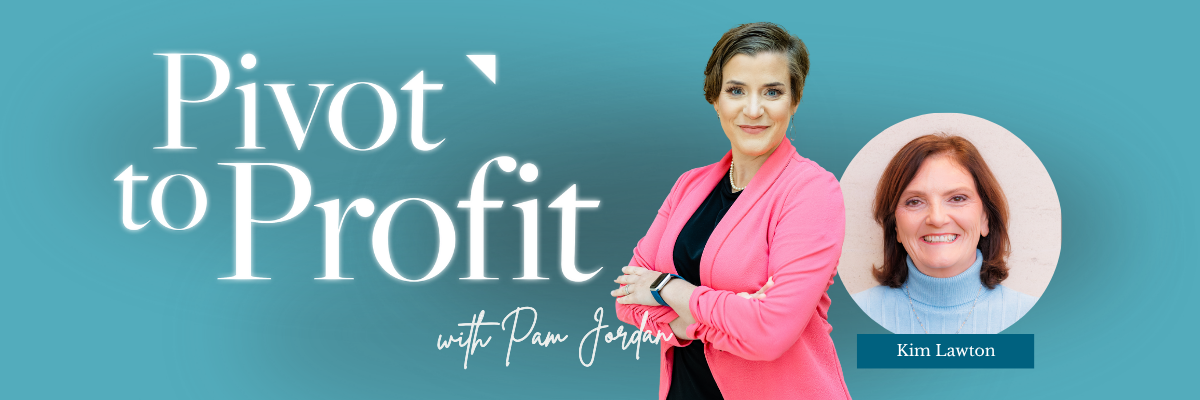
Pam Jordan sat down with Kim Lawton, award-winning marketing veteran and co-founder of Inspira Marketing Group and Enthuse Marketing, for a candid conversation about entrepreneurship, marketing strategy, and the often-overlooked connection between marketing and financial health.
Kim Lawton’s entrepreneurial journey began early—at just 14 years old—when she challenged her father’s approach to running his pizza shop and was promptly handed the keys to prove her point. That formative experience introduced her to margins, staffing, and cash flow, lessons that would later shape her leadership style as a marketing agency owner. Although she once dreamed of becoming a criminal defense attorney, Kim ultimately found her calling in marketing, where problem-solving, storytelling, and relationship-building intersect.
Today, Kim leads two distinct but philosophically aligned agencies. Inspira Marketing Group focuses on consumer-facing brand experiences, helping companies build emotional connections through experiential and integrated marketing. Enthuse Marketing, on the other hand, centers on education-driven marketing, particularly for hospitality and beverage brands, by equipping buyers and decision-makers with the knowledge they need to confidently choose and promote products.
A key theme of the episode was Kim’s belief that strong marketing starts with asking better questions. She cautioned business owners against chasing trends—like pop-up events or viral moments—without first understanding their goals and audience. Effective marketing, she explained, is not about doing what’s popular, but about doing what’s purposeful and aligned with the customer relationship.
From a financial perspective, Kim emphasized the importance of tracking meaningful data. Rather than focusing solely on vanity metrics, her teams measure brand awareness, trial, and purchase intent to guide smarter decisions. As a CEO, she prioritizes lifetime value (LTV) over short-term revenue, believing long-term client relationships drive profitability, stability, and culture.
Looking ahead, Kim is expanding her impact through the Enthuse Foundation, a nonprofit that has already provided $1 million in non-dilutive capital to women-owned businesses. Her vision underscores a powerful message echoed throughout the episode: sustainable growth, rooted in profit and purpose, creates the greatest opportunity for lasting success.
EPISODE TRANSCRIPT
0:00
Welcome to the Pivot to Profit podcast, where we believe that understanding your numbers is the key to freedom of time and money.
Because at the end of the day, it's really not about what you make, it's about what you keep.
So each week, we're going to bring you real stories from real entrepreneurs who have faced the challenges of growing a business.
0:22
We'll also dive into how numbers have helped and sometimes hurt them, and gaining clarity over their finances has unlocked new levels of profit and freedom.
Hello and welcome to today's episode of Pivot to Profit, where we help entrepreneurs better understand their numbers and their business by telling amazing stories from entrepreneurs out there.
0:44
Today's guest is the amazing Kim Lawton.
How are you, Kim?
I'm doing well, thank you.
I am so pumped to have you here because you're a marketing expert and so often people don't realize the strong tie between financials and marketing.
So let me officially introduce you.
1:01
Kim is an award-winning marketing team veteran and Co founder of two successful agencies, Inspira Marketing Group and Enthused Marketing These companies.
Kim's helps brands of all sizes build visibility and create meaningful connections with consumers using cutting edge marketing strategies.
1:19
Kim overseas creative account and production teams to ensure every client's vision comes to life.
Her honest, straightforward style and deep industry experience have made her a trusted leader and a force behind the success of all of her companies.
All right, Queen, are you?
1:35
Ready.
I'm ready.
So the first.
Question is, what did little Kim want to be when she?
Grew up not the journey that I've taken, I'll tell you.
I grew up in the era of John Grisham and courtroom dramas.
So my intention and plan was to be, for such a long time, a criminal defense lawyer.
1:54
I loved problem solving, digging into insights and just uncovering puzzles, I'll say.
I love it.
So what was little Kim who wanted to be that trial lawyer?
What were you taught about money?
Was money good?
Was money bad, should you want it?
All of those things I was.
2:10
Always tied to understanding money.
I grew up in a household of we had to work.
My dad owned businesses.
It was actually my first entree into entrepreneurship by accidental.
I was telling my dad one day, I don't know why I was so bold at that age.
2:26
It was about 14 and I told him I didn't think he was running his pizza shop very well and he could make more money and it was probably too confident because he handed me the keys and told me to start running it myself if I could do better.
I'm.
Sure, that was some lessons learned along the way.
2:43
Restaurants are hard.
But what a great way to suddenly be part of like margin and staffing and how everything tied together and in paying for things that were a business and it was basically a reality check at a very young age.
2:58
Yes.
So how did you go from running your dad's pizza shop to now veteran marketer?
So tell us about that journey.
Yeah.
Sure.
The second business came from seeing a gap in the marketing world.
I moved to Arizona after college and when I decided that I didn't want to be a lawyer anymore, I didn't think it was a people business.
3:18
It was very much of A research and and digging into books.
Instead of being out in the real world.
I shifted my career or my education into marketing and business.
Absolutely loved it.
Found my place if you will.
Maybe it was that entrepreneur journey that also helped get the wheels turning a little faster.
3:38
But I moved to Arizona, I was working in media, so traditional media advertising, and I stumbled across an ad in our publication for a brand ambassador for a spirits company.
And as I was reading the job description, it felt like this dream job.
3:53
But as I look back on that, it really was because now my business partner was my first boss at that job.
And that was in 1998.
So we've been working together building businesses for almost 30 years.
That's amazing.
So you're still partners?
Today, yes, yes.
4:09
That is amazing, impressive.
So you have two companies, 1 is a branding agency, 1 is education.
So help us understand the difference between the two and the different services that they.
Provide Absolutely.
I'm going to start with the commonality between the two.
4:25
My business partner and I, we worked for several agencies throughout our careers and we always kind of came back to each other.
Even if he went on to 1 and I went on to another agency, we'd have these what I'd call input sessions of what we thought was if we had our own company, what would that look like and what would we do differently?
4:43
Why would it all, any of it matter?
And I think the, the things that we grounded ourselves in and had so much commonality were about a place where people were put first in agencies, especially creative agencies, you're always looking at the output versus the inputs.
5:00
And we thought that needed to shift because if you have people that were wanting to come to work every day and inspired by the work they do, that would translate into good work because they wanted to do that for their clients.
And teaching our team members and anybody who worked in the agency that the value of that client relationship and how the client relationship is more than just being friendly or having dinners or that kind of like surface level relationship.
5:28
It was really like, what is their KPI?
What is their goal?
How are they being bonused?
What is their role within the organization?
And then how does that organization work?
How does that brand come to life?
And knowing the business as intimately as their clients was something we impressed and taught.
5:45
And it was always the philosophy of when you have trust in people and you have good clients, you're going to have great work.
And so that became the foundation of both agencies.
And that's why I kind of wanted to say like they both have this fundamental way of working.
6:00
They just show up differently to the outside world.
That commonality, and that's how you bring power.
So tell us about the differences.
So the difference is 1 Spiral marketing does everything consumer facing.
So if you can think of experiential integrated work and anything that a brand and a consumer would connect in, that's the work that the agency does at Inspira.
6:23
For Enthuse, it's a little bit different in terms of how we lead with education.
So my business partner, my other business partner's wife, we have to take the whole.
We started enthused together and she was a former teacher and there was a brilliant opportunity, I'll call it, of a client coming to us wanting some specific work.
6:46
And once that work was being defined and we were going through the brief, we recognized that it was storytelling, but it was more so from the lens of connecting with a customer.
So the buyer of that brand that goes into their store, I wouldn't go as far to say it's AB to B market, but it's really the customer that is putting the brand on the shelf.
7:08
So if you think in hospitality, a bar, restaurant, hotel, when they have a brand on their shelf that they're selling to their consumers, it's that middle ground of talking to those gatekeepers in that way and doing it through the lens of.
Education.
I love how holistic it is.
7:24
It's the education, but then also the client facing with the heart of getting to know your clients.
So when clients come to you, what are their challenges?
What struggles are they saying?
What are their pain points?
Most for either agency, it's the relationship they have with their consumers.
7:40
That's really the work that we do at Inspira of building and growing that.
And that's why it's not so specific in terms of we only do experiential, we only do integrated, we only do above the line or below the line.
It's very much of like where there's a need for a consumer to understand and have a more intimate relationship and that can come through the lens of an experience or it can be on, but it's what is that and what's going to help build that relationship.
8:08
So to kind of dig into that with clients, they typically come to us with, I need to get this product into the hands of consumers.
I need to sample it, I need to try it, I need consumers to try it because once they try this new product that we've launched, they're wowed and they want to buy it.
8:25
So a lot of it is that emotional connection with Inspiron and then with Enthus, it's all more like there's 20 tequilas out there.
Why am I buying this one for the my consumers and why does it matter?
So that education is so important in terms of how does it make a consistent cocktail?
8:44
You know your delivery is going to be on time because we have enough inventory.
It's made that like with consistency because of the blenders.
Like all of a sudden that education to that buyer becomes very relevant because right now in our world with AI, you can ask ChatGPT anything and get a bevy of information.
9:04
So now it's adding that layer of education to say, wait, is this the right product?
And how is it going to connect with the the people that are coming in into my establishment?
So it's very different in terms of the problems the clients are coming to us with.
9:20
Obviously it's a very relationship driven focus that you take with your marketing, so give us some advice.
Where are do you see people missing the mark when they try to connect to their audience and not appreciate that relationship?
Where are they screwing up where you're able to come in and bring value?
9:38
I think the biggest one that we see often is chasing a trend.
Oftentimes clients will come to us and like we want to do a pop up because we saw everybody on Instagram doing XYZ and it's like, well, why?
And like, what's your goal and does it need to come through in that way?
9:56
What are the, the true value of what you're really trying to accomplish?
And so asking the right questions, I think often as Mark, we try to go do right away and get excited about what the client maybe had as a vision.
And we have to diligently not only teach our teams to do it, but even also just stop and ask questions because then you can get to the real solution versus jumping to solutions because you could get really excited.
10:24
This idea could win an award.
But if it's not going to actually build that brand and grow that brand, that's where we have to stop and take a pause.
And it's so hard to do do because we get so excited about some of our clients ideas.
Yes, because these trends can just take off and you're like, for example, the pop ups, oh, pop ups are everywhere.
10:42
Everyone's doing a pop up.
Let me go.
I need a trailer.
I need a, an event.
I need to be at the, you know, whatever trade show at the Convention Center, at the farmers market, whatever it is like I want to be there.
I want to be there.
But I hear what you're saying is, but why and how does that help you build the brand relationship with your clients?
10:59
Because if your clients are 40 plus year old working moms, they're not going to be at Coachella, right?
Like that's not going to be where they're at.
So trying to match that.
I love it.
So obviously marketing has to be data-driven.
So what's some data points that you track with your clients to be able to show that the efforts are working, the event was successful, or the brand recognition with the relationships with the clients is going well?
11:22
Give us some metrics that you guys currently track.
So 1 is we survey consumers coming through anyone of our footprints.
So it's not just the data of how many people came through and how many samples we gave out, which are basically table stakes in those types of events.
11:40
What we do is we have a survey of, it's super simple in terms of three main questions before coming through.
Have you heard of this brand before?
Have you bought it before and if so, in the past, how far it was, so if it's a turn or not.
So we ask if you bought it in the last three months.
11:56
And then the last question is based on today's experience, would you purchase it and kind of an intent question.
Now, a lot of people challenge this in terms of like, well, of course I'm going to say I'm going to buy it, but do I actually do that?
So we do a lot of back end research to say how you act in the moment is, you know, what's the potential.
12:17
So we backed down those numbers.
But once you start to aggregate data like that, you can really provide clients with are we talking to loyal consumers already?
Are we talking to people that have never heard about the brand?
And then you can start to shift your strategy on what types of events you're going to.
12:33
So if you're you're going to a football tailgate and everybody knows your brand, you might not want to go there anymore because you're already talking to people who buy your brand.
So that's more of a loyalty play.
But then you shift and say going to NFL versus college, college games, we're not seeing anybody who buys our brand.
12:51
So there's a different strategy we take to do that trial.
So what that data does, it gives us directionally a lot of valuable information to clients to say what and how and where are the places to go to gain these trial opportunities, so.
13:06
You're really about building the relationships through experiences between the brand and the end user so that they feel connected to it.
Purveyor or like I'm AI don't know a casualty of that.
I don't know.
There's a specific beverage.
It's a non alcoholic beverage that I knew nothing about and my husband and I were at an event and they had a little pop up thing and they had these mocktails that they were mixing and I was like, Oh my gosh, this is so good.
13:31
And then the next time we went to the store and we saw it on the shelf, we for sure grabbed, you know, a six pack of it and now we have that brand of ginger beer in our fridge.
Absolutely.
And those are the important points of being in the right places to the point of if you're going to be a potential consumer, we want to be in places where you'd naturally try it as well.
13:54
We don't want to be in places where it doesn't seem to fit the environment.
And then it just becomes like, why did I get this here and you don't remember it as well?
I love it.
So now let's put on your CEO owner hat because now you've been in business for a long time, helped a lot of people.
14:10
How do you going from a 14 year old saying dad, you can run your pizza shop better to now running these marketing?
How do you manage the money?
What is your role?
What metrics do you review with your team to make sure that you're on track yourself with your?
Clients.
Yeah, it's a great question.
14:27
I thankfully I've always been wired to have money.
I'm an operator by through and through.
If you subscribe to what's iOS, there's the visionary and the operator.
I am the operator.
So I'm always thinking of how money's coming in, where is it going, how is it going to be spent?
14:42
Are we going to get a long term value?
And it's, it's just a not intuitive sense for me.
But I think what we look at, and it's probably goes against most agencies as well.
And I think that's what I love about the partnership that I've formed with my business partner and partners on both sides of the agency is we look at even long term value of clients.
15:05
We call it the lifetime value of a client.
Our job is not to look at headcount and cost per or revenue per client and revenue per headcount and how many billable hours versus this project and this project.
We do not dig into those numbers at all.
15:21
Now are those numbers valuable?
Absolutely.
And do we know where they are?
Yes.
However, that's not what we see as moving the needle in our business.
What we see moving the needle in our business is this lifetime value.
So every year that we don't have to go sell a new client, what's that financial?
15:41
What does that give us back and how can we fuel that back into investing in our team, investing in training and tools to learn more about that client's business?
And I think that's in my mind, looking at the long term versus the short term, we can go sell it and get a lot of new clients, but if they don't stay, that actually is detrimental to the culture of the company.
16:04
It's detrimental to your books because you're always chasing after a new client.
And there it takes a lot.
Takes about 10 times more time and effort to go get a new client than it does to simply grow an existing client.
So LTV is your driver.
What is next on the horizon for you and your agencies?
16:21
What's coming up in for you?
So one of the biggest things that we are looking to do and it's because I have two businesses that I don't have enough time with them.
I have to do another project which was started about 7 years ago and it was the Enthused foundation, it's our nonprofit for women entrepreneur.
16:41
I was excited to say that in 2025 we have now provided $1 million in non diluted of capital into women owned businesses.
So my big goal is double that.
It's been a passion project that has grown.
16:59
But when I say how we grow that and what we look forward to is growing the client business at Enthused Marketing because Enthused Marketing profits go directly into the foundation.
So the more business and the more profit we make within Enthused Marketing, we can directly impact the foundation.
17:19
But the big thing for the foundation is to grow our board of directors to to get our bigger voice.
We had an amazing partnership with Amazon this year and we want to grow that so that we can get to more cities and do more work than just the tri-state area of New York, Connecticut and New Jersey.
17:36
That is amazing.
I love that you're taking the growth and the value that you're bringing to the clients through the profits and then putting into that foundation and and helping female entrepreneurs.
That's magical.
Kim this has been an amazing conversation where can people can connect with you.
Connect with me on LinkedIn, it's Kim Lawton enthused.
17:52
Marketing or Enthused Foundation and we also have our agency websites which are Enthused Marketing and Inspira Marketing.
And then you can connect with me at Enthuse Kim on Instagram.
Love it.
I love the excitement that you have for all that.
18:09
You're doing amazing.
Thank you so much for sharing your profit story with us.
And that's all for today's episode of Pivot to Profit.
Remember, it's all about understanding your numbers and it's not about what you make that matters.
It's what you keep.
Thank you.