How 7-Figure Founders Scale to $10 Million: Leadership Lessons from Brett Gilliland
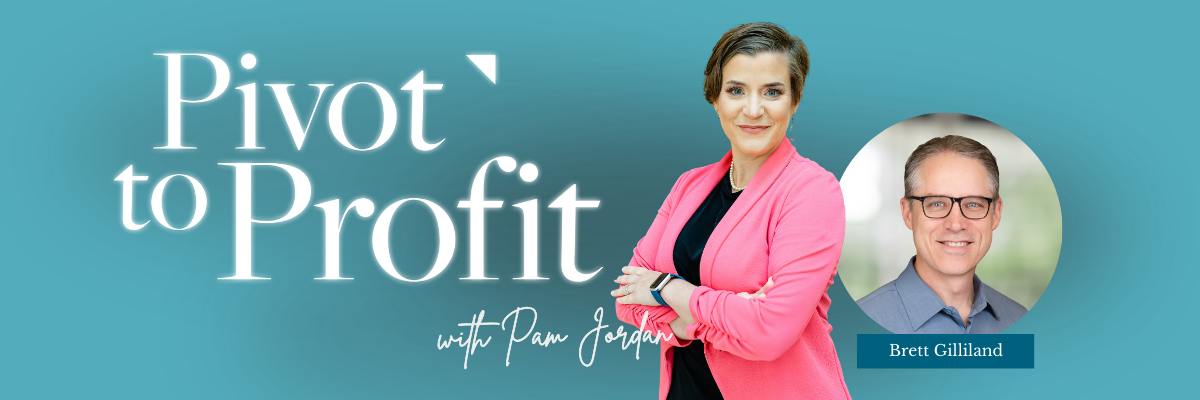
On a recent episode of the Pivot to Profit podcast, Pam Jordan sat down with Brett Gilliland, founder and CEO of Elite Entrepreneurs, to unpack what it really takes to scale a business from $1 million to $10 million and beyond.
Brett’s journey is anything but typical. After earning a master’s degree in organizational behavior, he helped scale Infusionsoft from $7 million to over $100 million in revenue. During that time, he built Elite Entrepreneurs inside the company before eventually buying and spinning it out in 2018. What followed was a crash course in entrepreneurship, complete with revenue drops, event losses during COVID, and the hard reality of building marketing systems from scratch.
But Brett’s story isn’t just about growth—it’s about intentional growth.
Why Most Businesses Plateau at $1 Million
According to Brett, only 3–5% of businesses ever reach $1 million in revenue. And for many founders, hitting seven figures doesn’t feel like freedom. It feels heavy.
Common challenges between $1–3 million include:
Feeling like the weight of the business rests solely on the owner
Struggling to hold team members accountable
Lacking clarity on long-term vision
Plateauing despite working harder than ever
This is where leadership—not hustle—becomes the differentiator.
The Shift from Operator to CEO
Brett emphasizes that businesses grow in stages. Just as a bicycle must shift gears to go faster, companies must evolve their leadership systems to scale.
At the $1–10 million level, the key isn’t just revenue growth. It’s organizational development.
Through Elite Entrepreneurs, Brett helps founders clarify three core elements:
Purpose – Why the business truly exists
Values – The behavioral standards that define culture
Mission – A clear, destination-driven “what by when” goal
Without this clarity, founders get stuck working in the business instead of on it.
People, Process, and Profit
While culture and leadership are essential, Brett is clear: numbers still matter.
He encourages founders to track revenue and profit first—but not to lead with them as the emotional rallying cry. Instead, financial metrics should support a compelling mission that enrolls employees at a deeper level.
As Simon Sinek says, “When people invest financially, they want a return. When they invest emotionally, they want to contribute.”
That emotional investment is what transforms a good company into a scalable one.
For founders ready to shift gears and build a business designed to last, this episode is a powerful reminder: growth requires clarity, accountability, and the courage to evolve.
And as Pam always says, it’s not what you make—it’s what you keep.
EPISODE TRANSCRIPT
0:00
Welcome to the Pivot to Profit podcast, where we believe that understanding your numbers is the key to freedom of time and money.
Because at the end of the day, it's really not about what you make, it's about what you keep.
So each week, we're going to bring you real stories from real entrepreneurs who have faced the challenges of growing a business.
0:22
We'll also dive into how numbers have helped and sometimes hurt them, and gaining clarity over their finances has unlocked new levels of profit and freedom.
Hello and welcome to today's episode of Pivot to Profit, where we talk all things money, all things helping founders own that seat and become the CEO that they were meant to be of their business.
0:47
Today's guest is the amazing Brett Gilliland.
How are you, Sir?
Very well, Pam, and I'm excited to be with you on your show.
This is incredible.
It's going to be fun.
Awesome.
So let me officially introduce you.
Brett is the founder and CEO of Elite Entrepreneurs, a company that specializes in giving $1,000,000 plus business owners the knowledge, processes and tools to grow to 10 million and beyond.
1:14
Brett is an expert in organizational development, leadership, and strategy and spent 10 years helping Infusionsoft grow from 7 million in revenue to over $100 million.
As the leader of Elite Entrepreneurs, Brett has helped hundreds of struggling 7 figure business owners overcome their biggest challenges and achieve new levels of success.
1:38
Amazing.
I can't wait to dive in.
But before we do, hey listener, if you're a business owner who needs to better understand your finances, are tired of surprise tax bills, we would love to support you at Pivot Business Group.
Just go to pamjordan.com and schedule a call.
All right, Brett, Are you ready for the first question?
1:56
I'm ready.
What did you want to be when you grew up?
So, you know, I don't know what it is about kids looking to their dads and saying dad does that.
Maybe I should do that.
So my dad was a general contractor.
I grew up in the Phoenix area.
And I saw him go off and build things and tear old things down and put new things up.
2:14
And I thought maybe I'll, maybe I'll do that.
So when I was a kid, I probably wanted to be a contractor.
OK, I love it.
And with an entrepreneurial dad, what were you taught about money?
Was money good?
Was money bad?
2:30
Tell me all the things.
Yeah, We were definitely taught to be very conservative with money.
So debt, very bad.
Debt bad.
Save for a rainy day, live beneath your means.
So I grew up in a very fiscally responsible household.
I would say those principles have served me well.
2:48
All right, so still still feel that debt is bad.
Well, consumer debt, yes, absolutely bad.
I think that there are times in our business, this is where leverage is a good thing.
And if you have high confidence in what's happening and you can put a little fuel on that fire and grow it better with a little bit of money or capital from the outside, I'm not against that.
3:11
So yeah, I try to avoid debt in my personal life, not against lines of credit or debt in business.
Awesome, so let's talk about your early career.
How did you get into Infusionsoft?
Yeah, so I I did a business degree thinking I'll get a business degree and go work with dad.
3:30
Well, I grew up in a large family and my dad decided he did not want us to have the burden of thinking we all have to figure out how to work with him or whatever.
So before I finished my undergraduate college degree, he shut the business down.
He's like taking that option off the table.
3:45
Guys, you're not doing that.
So then plans kind of shifted and I, I was like, OK, I guess I got to go find a real job out there in the world.
And I, and I worked in customer service for a couple years after my business undergrad.
I thought, I'm going to get some frontline customer experience that'll help me be a Better Business person.
4:02
It was stressful.
I, I worked at a very stressful job.
I thought I got to, I got to do something else.
I don't know what it is, but I got to do something else.
And my wife reminded me at the time, hey, you've really liked those.
They were called organizational behavior classes.
It's kind of how people and systems work in an organization, kind of like that stuff.
4:23
And and so I'm like, yeah, you're right.
I do, I do like that.
And so I went and got a master's degree in organizational behavior, which just means I geek out on helping organizations be really effective.
And I went out and started helping organizations be effective.
Part of my career.
4:39
I was consulting small businesses on how to do this stuff.
I started in big business, that whole story, starting big business, got out of that, went to small business because I felt like it could really change things, make a difference, do some things that were just felt impossible in large corporate America.
4:57
So anyway, I was a consultant.
I went to Infusionsoft and said, I think I can help you scale this thing.
And they bought it.
I started working with them and then eight or nine months into the consulting arrangement, I was like, I need to be doing this.
And they felt the same.
And they're like, we need you to be doing this.
5:12
And so I jumped in and spent 10 years helping them do their growth.
OK.
So all that organizational development had huge value there.
So after 10 years there, then what is that when you started Elite Entrepreneurs?
Yeah.
So trick question, yes, Slash, no.
5:30
So Infusionsoft is a software company and my business, the elite business was born inside of that software company.
When you're serving 10s of thousands of small businesses with software, which is what we did with Infusionsoft and they see how well your company is growing, you're you're scaling, you're winning Best place to work awards.
5:49
They love interacting with your people who are like, how are you doing all this company building stuff?
Could you teach us how to do it?
And so inside of Infusionsoft, we built the elite business for about 6 years.
We grew it inside of the larger company, so $100 million software company, $1,000,000 teaching and and training and coaching business, let's say.
6:11
And then in February of 2018, so 8 years ago now, I bought that little business, that elite business and we spun it out.
So officially on its own since February of 20, 18, but we had grown it for 6 1/2 years inside of that company before that.
6:30
But you kind of were like an ink in an incubator of this bigger company.
So that's amazing.
Did you approach them and say I want, I want to do this on my own, I want to buy or did how did that go down?
So you might imagine this happening, Pam or listeners could see how this would happen overtime as a business grows, sometimes there's things that have spun up that that just don't really fit the strategic direction.
6:56
Like we're a software company, we're not a training and coaching business.
And and so even though it's profitable and it's adding cash to our to our efforts over here, it's still just not core to who we are.
And so when it's time to go from 100 million to beyond, it's like you got to get really dialed in again.
7:14
And so they, they had decided, and I was part, I should say we right, I was part of the leadership conversation.
But we decided, hey, we're not going to do this little part of the business.
We're not going to do that anymore.
We're not going to do the elite thing anymore.
And at that moment I was like, oh, that's, you know, that's my baby here.
7:30
Like I'm going to do that.
And so we had a little team that was dedicated to that business.
And I went to the team and said, hey, we're going out on our own.
Who who would like to continue to do this.
And there, there were only four others.
And me of the four that were involved, one said, yeah, I'm going to come and do that with you.
7:49
So there were two of us in a well funded startup.
We already had, you know, we already had customers, we had a community.
So that part was cool.
But we had, we had no marketing, we had no lead Gen., no customer acquisition, nothing because it was all within that other ecosystem, right?
8:04
So it was a fun, fun learning journey.
The first few years.
I didn't ever start out to launch this business.
It happened organically in a place where I, I feel very fortunate.
I don't have like the road rash on my face from grinding it out.
It it kind of stood up in that other business.
8:22
And then, you know, we had some painful lessons after, but I didn't I didn't really go through the painful startup journey.
So for that I I just admit that everybody else listening, you're better than I am.
I didn't do that and I'm thankful.
I don't know if I could have.
I honor what you all do.
It's crazy and great.
8:39
Well, everyone has their own journey and being able to be an incubator inside of a new Fusionsoft of, you know, $100 million company doesn't suck either.
But I hear what you're saying is they decided when now that we're going to scale all these other spin offs that weren't who we with the next stage of our company is aren't part of our ecosystem.
8:59
And I see that a lot as companies grow is, Oh, well, that service isn't providing us, you know, it isn't in alignment with who we are anymore.
Need to let it go.
But what's great for you is you're like, great, that's my passion.
I'll buy it.
And off we go with your one employee.
9:15
So in those early days when it was you outside of Infusionsoft with your one employee, tell me about an early financial win where you're like, oh, I can do this on my own.
Yeah, those questions were definitely swirling for me, right.
It's like we don't have a website, can we even get customers?
9:31
And so we went from that first year in business, we went from like a million and a half and dropped immediately to 900,000 that first year.
It was just like boom, right.
But you know, 900,000 still fuels a couple people pretty well.
9:46
So that, that was OK.
But the nervous part was, is that we were, we were spending, I wish most of that went to the bottom line.
We were spending on live events.
And so there was, there was a lot of spend going and we didn't have any like sponsors.
So any events we put on and we did quarterly, we did 2 flavors of quarterly events, an initial like boot camp type of thing to bring customers into our programs.
10:12
And so that's an event every quarter and then an ongoing recurring membership type of event every quarter.
So the cash was going out to these events and I wasn't, I wasn't figuring out fast enough how to replace the people who were leaving.
So that that was the nervousness there for sure.
10:30
It was like, OK, how long does this last?
Right.
So we dropped as much as we did that first year.
The second year, you know, we only dropped from 900K to 720.
And that was in 2019.
And you know, exactly what happened in 2020.
10:45
So then it was like, this is do or die immediately.
We, we lost when, when COVID hit live event stuff, we lost about a third of our customers who were reeling from, from COVID as well.
And so, you know, we were down in this like 450 run rate territory.
11:02
I was like, I don't, I don't know if we're going to make it so that that's the, that's the setup for the, you know, the, the financial panic of 2020, our version of it.
So how did you turn that around?
It had.
It had to happen in 2020.
It actually had to happen in 2020.
11:17
So, you know, sometimes you get invited by external factors to do something different.
I'm I'm not the first to innovate.
I will admit that publicly.
Everybody knows me privately we go, Yep, Brett has, you know, an iPhone 11.
11:32
Like he doesn't innovate.
He doesn't.
I like have zero need to like do the new thing.
I'm very good at preserving the core.
So Jim Collins talks about a built to last company, which is what we did at Infusionsoft.
And there was this preserve the core piece and a stimulate progress piece.
11:51
So that's kind of the yin and Yang.
And I'm, I'm fabulous at consistent preserve the core kind of stuff.
So the, you know, when the market says you can't preserve the core, you don't get to do what you were doing.
It's like, OK, I'm getting smacked across the head.
12:07
I I know I got to change something.
And so in 2020, we couldn't do you know, the 2 1/2 day or the two day boot camps that brought our new members in.
And, and so we did the obvious, probably maybe for all of you, it was the obvious.
12:23
We had to create a virtual version of that.
And nobody really wants to sit on a, on a Zoom meeting or a Teams meeting for two days straight.
So we had to change the way that we designed that delivery and what goes into it.
And then we had we brought the price point way down to match the offering we were putting together.
12:44
And thankfully by the end of 2020 we had, we had had more members and than we had had, you know since since we had left.
So we were able to turn it around by changing our product and our pricing and just pivoting.
So tell me about where you are now.
13:00
What is elite entrepreneurs look like today?
Yeah.
So now we have our our community is very solid.
I would say stable is a good word for it.
One thing that they haven't solved in the last five years is the, the consistent engine for bringing in new members.
13:18
So thankfully we have a great track record of serving small businesses.
So we get, we get plenty of referral businesses and referral business.
And, and if I get a chance to go speak that works.
And you know, all, all the things we do to get get them in.
But I really haven't cracked the marketing nut.
13:36
So we have, we have four team members today, not 2, you know, profitable.
We, I, I intend to grow this year, but we'll see how well I do the, the marketing thing.
OK.
So marketing, marketing is the piece.
So right now you're focusing on $1,000,000 business, 7 figure businesses.
13:55
Why have you identified that is the size that you want to invest in?
Oh, thank you for asking that, it's so great.
Well, you already heard that.
I don't know what zero to 1,000,000 actually entails.
I've seen a lot of people do it, but I don't know what that entails.
14:12
And actually this, this introduces a really important topic for me.
Businesses grow through stages, OK, just like human development, right?
Infant, toddler, preschooler, right, all the way up to adult.
There, there are very known stages of human development and businesses have a similar, a similar pattern.
14:32
I mean, we, we talk about the ones and threes of revenue.
Pam, you might appreciate this because you're a numbers gal.
One one to three is tripling in your business, right?
100,000 to 300,000.
And before that it's like 30,000 to 100,000, right?
It's like there's this transition from trading dollars per hour.
14:50
So like I actually stood something up 30,000 to 100,100 thousand to to 300,300 thousand to 1,000,000.
And every time you triple you, you sort of Max out the gear or the stage that you're in.
If you're thinking about a bicycle analogy, you Max out that gear and no amount of peddling is going to get you significant yield, right?
15:12
Like you might get a little bit more yield out of that thing by just killing it with the peddling.
But at some point you're going to wear out doing that.
So until or unless you learn how to shift that gear, you're, you're just going to wear yourself out in that in that gear.
15:27
So we see a lot of businesses tap out.
They they sort of plateau somewhere usually on one of those ones and threes that I was talking about and what we do, the reason that that seven figures for us is there's a 1 to 3 million and a three to 10 million.
That area right there is where we are exceptional.
15:44
Before that, I got a lot of empathy.
I even might even have some ideas that I've heard other people talk about, but that's not our expertise.
But where where The thing is working.
We got the thing off the ground.
We know how to get and serve customers, but now we're running into organization development, leadership, people complexity, organization kind of of challenges.
16:06
We're really good at company building and that in that one to 10 space is where the beginnings of that really needs to happen. 100% but and I've heard there's all kinds of statistics, but zero to 1,000,000 is impossible right?
Like very few companies get there.
16:21
Less than 2% of female founded businesses get there, but then 1 to 3,000,000 is a whole nother animal and three to 10 is like climbing Mount Everest.
So at those different intervals, what are you seeing?
Common struggles of CEO's and founders at those stages because you're working with so many founders and that there's got to be some common threads.
16:44
So share what you see.
Totally, and between 1 and 3 million in particular.
This is like, I feel like I have the weight of the world on my shoulders.
I thought it was going to be, you know, a big celebration milestone to get to 6 or to seven figures.
And it is like, yeah, you got to got to a million and then you you joined.
17:03
And it's reason our business is called the Lead Entrepreneurs.
Of the 100 that started, only three to five are left at that $1,000,000 mark.
Like you mentioned the female founder stat, but the the all founder stat is 3 to 5% get to 1,000,000.
17:19
So it's not that many.
And then it's like, OK, yay success.
But I feel like I have less time and maybe I'm even taking home less than I was when it was easier at 500,000 or, you know, somewhere in the rearview mirror.
And I just don't know how I could even grow beyond this without stretching myself apart.
17:36
Right.
So that's a normal feeling, the feeling of or the sentiment of, you know, I wish my people would, would just think and act more like owners like, or another way of saying that is more employees, more headaches, right?
Like there's this view that some, some business owners have of people are problems And and that happens when you don't set the thing up correctly and hire great people and give them clear ownership with accountability.
18:05
That's another pain.
Actually.
It's like, I wish I were better at holding my people accountable.
Like I can't, I'm not very good at that.
We don't have a clear plan about where we're going.
I'm just trying to survive.
Like there's, there's so many manifestations of the symptoms that happen around that stage.
18:21
We could talk a long time about, you know, various versions of it, but those are some some core ones.
People is definitely a hard 1.
So how do you help people in your elite entrepreneurs program build a team?
18:36
Because it is so true that the people who get you here aren't the people that are going to get you there.
So what tools do you have?
What wisdom do you have to help the people in your in your program break free of that?
So, you know, everybody talks Pam about you got to work, you got to spend more time working on the business and not just in it.
18:56
And I, I wholeheartedly second that.
I'm like, yes, that's true.
That is a truth.
The problem is most, and that's usually where that truth stops.
It's like people have some ideas, like I know I'm supposed to have a vision or I'm supposed to have values, I'm supposed to have a mission.
19:13
But people don't really know how to take those concepts that are fairly, fairly well known, like I should do those things and actually unleash the power of doing them well in your business.
So we start with total clarity around why the business.
So our framework is purpose, values, mission.
19:29
And that that follows a a framework that Jim Collins talks about in a book called Beyond Entrepreneurship that most people have never heard of.
It's the first book he ever wrote before he got famous.
And in that book he talks about purpose and values and mission.
And he says your number one job as a leader is to set a vision.
19:48
And so if that's the number one job and we got a lot of uncertainty about how to take this thing and go forward, we teach people and invite these these business owners to bring the right group of people from their team.
It could be their whole team if there's six or eight of them, or it could be like the key people that the leadership team, if there's 15 or 18 of them or something.
20:11
But we we help them get super intentional in a Co creative fashion around purpose values and a very what by when.
Destination oriented mission, not a bland mission statement, but a we're mission driven and that's where we're going.
20:28
So we help them get really clear on that for working on the business.
And then we help them with the meeting rhythms or cadence to do this juggling act between operational excellence, day-to-day getting and serving of customers, clients, patients, members, whoever pays you and the working on the business strategic progress work that most of us ignore.
20:49
And so a really good meeting rhythm will allow you to do both of those things.
But most people just get sucked into the day-to-day whirlwind and they never quite get over to this business building work or working on the business.
And so we help them get really intentional.
Then we help them with help them with rhythms around planning and execution to make both those things happen.
21:08
And it's creating the systems and processes is what I'm hearing you say.
It's here's the vision, here's the mission, here's what we're after, and then here's the process, the meeting cadence, what we're going to hold each other accountable to.
That brings the full impact.
Because you can't be a $10 million company and have BC players that aren't all rowing in the same direction.
21:31
That's right, the rowing in the same direction has like 2 parts to it, right?
One is they actually know how to do the job well and, and their effort is aligned, you know, growing in the same direction in their effort.
The other is how they operate with the and that's where the values come in.
So I think we started this part of the conversation around people and getting that part right.
21:50
And you can't do it unless you're very clear about here's what it looks like to behave.
Here are the behavior standards, right here's our operating norms.
And that's, that's what really good core values do.
And, and a lot of companies know they need them.
So they're like, Oh yeah, we have our values.
22:07
But most, most owners fall short of actually breathing life into the company culture through a shared purpose and values that shared identity of why we do this everyday and how we work with each other.
That's what makes us, us.
22:23
And most businesses have a hard time getting clear on that and then like hire hiring, leading and firing to that.
Absolutely.
Yeah, your core values are we hire and fire both team members and clients based on those core values.
So I love it.
Brett, can you share a success story of one of your members and how you help them through the drudge of 1 to 10 million?
22:48
So actually we do quarterly events for our community, for our members, and we just had one a couple weeks ago.
And I actually invested a fair amount of money to fly somebody out from Australia to come and speak to our group because she came, she and her husband came to Elite years ago and they were almost a million, OK.
23:08
They were in that Infusionsoft ecosystem.
They were having success with the software, their business was growing and they were about a million.
And then they heard about this Elite, you know, company building stuff and they're like, OK, we're going to go learn how to do this.
So Fast forward years later, I brought her back because they're doing well north of 10 million now.
23:29
They have hundreds of people across Australia.
So the punchline on this is this is a commercial cleaning company, OK.
And it almost doesn't matter what kind of company it is, as long as it's, it's like we need to have or hire more people in order to grow.
If it, if it requires people, then what we teach is, is going to be very useful.
23:49
So she has this army of cleaners across the whole country and is doing multiple 8 figures.
And she and her husband have kind of defied the odds of what a cleaning company can become.
The last year in Australia, they were the number one best company to work for in the country, commercial cleaning company.
24:10
Now we don't go around saying, hey, come spend time with us, we'll make you a best place to work.
But that's, that's exactly what happens when you get this clear vision and then you hire lead and fire to it and you create a place that enrolls people emotionally because of the purpose, because of the values.
24:26
And I use that word emotionally.
We don't use it a lot in business.
But let me share a Simon Sinek quote that I think will drive the point home.
He says when people invest financially, you'll like this.
When people invest financially, they want a return.
Makes sense, right?
When people invest emotionally, they want to contribute.
24:46
There's the unlock for the people part of it.
Now we need, we need financially savvy business owners.
We need all the right finance systems so that we run a very healthy, financially viable, strong company.
And if you try to lead your company on numbers alone and you just make it transactional.
25:05
So hey employee, I will pay you this for, for that return, then you lose an opportunity to enroll people in something that we're doing this together.
And when you when you can do it in a together way and have all the right financial pieces in place, it's just it's incredible what's possible.
25:25
I love it.
So talking about finances, because it is a balance.
It's not just finances, it is people, it's processes, it's vision.
But when you're working with these businesses who are trying to scale and grow their business, what financial metrics do you encourage them to focus on or track?
25:43
Because it can't just be people and vision.
Numbers do have to matter.
No, totally, totally have to matter.
And, and the way that we teach the, the vision setting work mission specifically, there's this like headline level mission.
We were, we're going to do this by the end of 2028.
26:00
Let's say I was creating a three-year mission right now, all of 26, all of 27, all of 28.
Here's what we're going to go accomplish together by the end of 2028.
I would recommend not putting revenue or profit in that headline because you can't enroll people transactionally to a number that they translate to.
26:19
Oh, that's just the business owner stuff in their pockets.
Like that's at some point the numbers don't hold their attention.
However, number one on the on the associated or or supporting mission goals would be revenue, profit retention.
26:35
You know what, whatever the key metrics are for that business beyond, beyond revenue and profit, like I'm going to start with those every time and say you're probably going to want revenue and profit as as two of your numbers.
But then after that, it's like, OK, what else is important in your business for a cleaning company, it might be the, you know, the average upsell that they can drive in in, in existing accounts rather than spending a lot more to go get new accounts.
27:01
How can we grow the business through current relationships that we have?
I'm using that as an example.
It might, it might not even be true for them, right?
But whatever it is that are like this is what drives a healthy business for our business.
Those those financial and operational metrics would be included in the process of getting clear on the mission.
27:20
I love it, I love it.
So as we wrap up, Brett, what is next for you?
What's 2026 bringing for you?
Well, 2026 is the year of partnerships for me.
And the reason I say that is all of the individual efforts, meaning, you know, 1 to one marketing efforts on a mass scale.
27:37
Like we try to do digital marketing and online this and online, you know, we're doing all that stuff, but that we've really failed to connect with people in that way.
And I want to leverage relationships through partnerships to get in front of the people who need what we do and have the the trusted voice of the leader of that group, right.
27:57
So if you had a community of businesses, Pam or you know, through a podcast like this, I can reach a, a group of these 7 figure businesses at the same time and serve them.
That allows me to achieve our mission and it allows me to help the partners that I'm working with.
28:13
And anyway, that's the focus this year.
Partnerships and referrals, wonderful way to grow business.
I love it.
Brett, thank you so much for sharing your profit story with us.
Where can people go to connect with you?
Thank you for asking.
Yeah.
So I do spend time on LinkedIn and this will sound a little cheesy, but my my LinkedIn profile or the handle is built to last champ because of that whole history of I'm the built to last guy.
28:38
We're going to do that in your company.
So built the number two last champ.
Our website for our Elite Entrepreneurs business is Grow with elite.com.
Awesome.
That's all for today's episode of Pivot to Profit.
Brett, thank you so much for sharing your wisdom with us.
28:54
If you need help understanding your numbers, increasing your profit and reducing your taxes, just go to pamjordan.com to schedule a call with my team.
And remember, it's not what you make that matters, it's what you keep.