Wealth Building for Entrepreneurs: Why Cash Flow Matters More Than Big Numbers
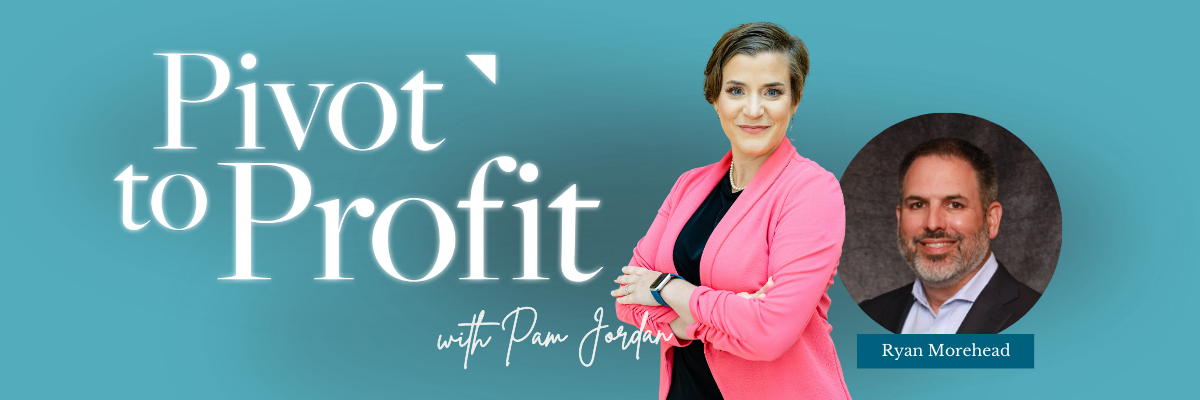
In a recent episode of Pivot to Profit, Pam Jordan sits down with financial strategist Ryan Morehead to unpack one of the most misunderstood topics for business owners: wealth building. While many entrepreneurs focus on hitting big net worth numbers, Ryan challenges that thinking with a simpler—and more powerful—question: How much cash flow do you actually need to live the life you want?
Ryan specializes in helping entrepreneurs improve retirement cash flow while taking on less risk and maintaining liquidity. One of the most common mistakes he sees? Letting excess cash sit idle in a bank account. While liquidity is critical for business owners, that money doesn’t have to be stagnant. With the right strategy, entrepreneurs can maintain access to capital while still putting their money to work.
The conversation also highlights a major disconnect between wealth accumulation and lifestyle goals. Most entrepreneurs don’t want a massive balance on paper—they want consistent, reliable income that supports travel, family time, and freedom. By working backward from desired lifestyle and cash flow needs, business owners can choose financial strategies that prioritize efficiency over hype.
Ryan emphasizes that there is no one-size-fits-all solution. Smart wealth building requires understanding risk tolerance, tax exposure, liquidity needs, and exit plans. Tools like real estate, market investments, and alternative financial vehicles can work together—when aligned with clear goals.
The takeaway? Stop chasing big numbers for the sake of ego. Focus on predictable cash flow, smarter strategy, and keeping more of what you earn. Because at the end of the day, it’s not about what you make—it’s about what you keep.
EPISODE TRANSCRIPT
0:00
Welcome to the Pivot to Profit podcast, where we believe that understanding your numbers is the key to freedom of time and money.
Because at the end of the day, it's really not about what you make, it's about what you keep.
So each week, we're going to bring you real stories from real entrepreneurs who have faced the challenges of growing a business.
0:22
We'll also dive into how numbers have helped and sometimes hurt them, and gaining clarity over their finances has unlocked new levels of profit and freedom.
Hello and welcome to today's episode of Pivot to Profit and We are.
0:39
Talking all things money.
And wealth building and investing.
So we have Ryan Morehead, the financial strategist who helps families and business owners gain clarity and confidence.
Around their wealth.
He believes people deserve to fully understand.
How their money works.
So he can help keep more of what they.
0:56
Earn Ryan.
And specialized in teaching entrepreneurs how to specifically improve retirement cash flow by saving less and taking on less risk without sacrificing liquidity so that they can make smarter.
Decisions with their next.
1:11
Steps and move forward with Peace of Mind.
So amazing Ryan, I cannot wait for you to share your wisdom with us so as we dive.
Into the first question.
What did you want to be when you grew up?
That's an interesting one.
I always thought I was going to be a Major League Baseball player.
I just dig into sports and like, I just.
1:28
Ryan Sandberg was my idol back in the 80s.
He played for the Cubs.
The Cubs are my favorite team.
And that's just what I thought I was going to do.
I played second base.
I was just going to be him.
Hey.
He's probably a lot better than me and more talent.
I'm kind of small, like at some point realization this isn't going to work, but but you know, probably the time I was 10 or 12, that's what I thought I was going to do.
1:47
Beautiful.
What did the little.
Second bass player.
Ryan, what did you think about money?
What were?
You taught about money.
What are your?
Parents, society, your community tell you was it good, bad, all of that?
You know, I grew up in a, in a kind of a stereotypical Sicilian family.
2:07
My mom's a descent that she was born in America.
She was American, but like my grandparents were literal, literal stereotypical Sicilian immigrants.
Little short people came over on the boat, the whole 9 yards.
Point is, there were just some things that I honestly like, I was just conditioned that, hey, you just don't talk about.
And money was one of them.
2:23
You just didn't talk about money.
You didn't ask me about money.
You didn't, you didn't ask where the bodies were buried.
Like there were just things you didn't ask about.
And so it was kind of, it was kind of taboo in my house to some degree.
I knew kind of financially like we had everything we needed and like I had most of what I wanted, but never really had a sense of like, hey, is it raining cash at my house or we kind of, you know, where we at.
2:42
So it's kind of something that was just kind of quiet, kind of hush hush.
You know, I kind of watched my dad who's who's entrepreneurial, like, hey, just make it and provide through sheer hard work, a lot of hours, weekend work, that sort of stuff.
So I kind of understood more work ethic and hard work and what it could provide, at least in terms of necessities.
2:59
Money itself really didn't talk about it very much.
That's.
Crazy.
Which is funny because you talk.
About money.
Every day, all day.
We're clients, so we decided we.
Weren't going to be.
A Major League.
Baseball player So what did you go to?
College for.
So I'm from New Orleans originally I went to, I went to Mississippi State and actually started as a communications major right when I figured out that I wasn't going to be a Major League player, I was going to be a broadcaster.
3:22
And that that lasted all of 1 semester.
And like I took this communications course and it was very nebulous to me.
And now when you look at look at me being a numbers guy and a financial guy, like 2 + 2 is always 4.
And that very first communications class, I couldn't get anything communications class, I couldn't get anything concrete.
3:38
I'm like, this is all very nebulous.
Like this is what communications is about.
Like I'm going to suffer.
So I said, you know what, I'm transferring to the Business School.
So I quickly, I transferred, I ended up majoring in banking and finance with kind of just the aspirations of get some corporate job, climb the corporate ladder, become CEO of some company, make a zillion dollars.
3:56
Money was never the goal, but it was always kind of just climbing the corporate ladder.
And so I thought I was just going to be a nine to five corporate working stiff forever.
When you got out of college.
Where did you start?
What was the beginning of Ryan's Morphus into now being an entrepreneur and helping other entrepreneurs?
4:11
Yeah.
So I had no clue what I wanted to do.
So I left Mississippi State, moved back to New Orleans and went to Graduate School because I didn't know what I wanted to do.
And, and I wanted to coach baseball in the summers.
So it was a way to go back to New Orleans and do that.
And and while I was in Graduate School, I started working in the Raising Cane's franchise, which is now very well known.
4:29
Todd Graves, the founder, is a billionaire.
Back then, they had 17 stores.
I worked at store number 14 and I thought great company by the way, great culture, right?
It's turned into a pretty big chicken empire.
Cool concept.
Just do one thing and do it really, really well And and I loved it, but I also worked it for six months, which is enough to know, hey, I don't want to be the restaurant business the rest of my life.
4:49
Retail very difficult, just not for me.
So I graduated my MBA and took a kind of, I would say a typical financial analysis type role for a small oil and gas company in New Orleans.
Ultimately, Hurricane Katrina moved to Houston, not because of the storm, but just kind of as a byproduct of a more advanced financial analysis job at an oil and gas company here in Houston, much, much larger company.
5:12
And kind of started working my way up until oil and gas went South and got laid off.
I was an overhead expense.
It's pretty typical in the oil and gas base.
At that point, I kind of had, I knew I had a little bit of entrepreneurial spirit in me at that point.
I didn't see it years before.
And I'm like, hey, I want to own my own business.
What the hell do I want to do?
5:27
I don't want to start something and invest a bunch of money.
And the phone rang and it was a recruiter from State Farm.
And I'm like, OK.
And I knew some State Farm agents.
I kind of knew a little bit about what was going on.
So when they called, I listened.
And I ended up actually my first entrepreneurial experience and only my first foray into the financial services space was through State Farm.
5:46
I, I worked there once I went through the training, I had my own State Farm office for a year, which was long enough to figure out I had no passion for car insurance, which is how State Farm, you know, I had no passion for this.
But back then they actually had their own bank and they actually had their own line of mutual funds.
6:02
And so I kind of really liked like the life insurance side and the financial services side.
So after a year, when I said, Hey, this isn't for me, I knew enough at that point to say, OK, hey, let me pivot into the like what I call the retail financial services end, right?
And that's, that's pretty, pretty broad brush.
6:18
And there's 1000 financial companies out there.
But that's kind of how I got into this entrepreneurial nonsense.
So now you have your own firm with your.
High net worth clients.
Specifically focusing on business.
Owners and entrepreneurs.
How did you?
Decide to go out on your own and pigeonhole business owners you know.
6:36
Honestly, when I first did in the financial services industry, I didn't know what I didn't know.
I didn't really know the path, but I found a company that I wanted to work with that at least had some things going that I wanted to get involved in.
And so it was kind of through, I kind of ended up in that path kind of by dumb luck, frankly.
Again, they reached out to me, I didn't reach out to them.
6:53
And so I kind of went to work with them for a little bit and I liked, I understood the concepts that they were trying to teach, which was just beyond traditional financial planning and more importantly, understood the math behind it.
I was able to, you know, kind of think this, hey, concrete, like here's the math behind your situation, you know, to take my opinion.
And so I kind of just, I, I liked the message and absorbed it and learned it and applied my own strengths to it and kind of ended up in this path really kind of just teaching people, hey, if we would, you know, think one or two steps beyond what we've been taught, we'd probably make different decisions.
7:22
Yeah, I love it and.
So now your focus is on.
Business owners and entrepreneurs.
So why is that your?
Heart because there's so many different ways I can help.
I have no issues.
I mean, I'll hope anybody right?
W2 it doesn't matter.
But on the entrepreneurial side, first of all, I'm an entrepreneur myself, right?
7:40
I have this financial practice.
I also own some real estate.
I own a residential and commercial cleaning company, Long Boring Stories.
But so I appreciate the entrepreneurial journey and so I just relate to it really well.
So a lot of times I just share with people what it is that do with my own money and why it really resonates with me.
7:57
But there's all sorts of different ways that I can help entrepreneurs because when an entrepreneur first starts out, nobody tells them, hey, should I be an LLC or an S Corp or C Corp and what the changes and how it matters, right?
When you're entrepreneur, you don't have any.
There's no HR department, you know the benefits, there's no, there's no group life insurance, there's no anything really.
8:15
And there's so many different ways that I can help.
It's just it's more fun and more exciting and there's just more strategies that the entrepreneur can utilize than the W2 person.
Now the W2 person has a lot of the same mathematical exposures.
They just show up a little bit differently.
Business owners do have.
8:32
So many more opportunities.
When it comes to wealth building and tax strategies, and especially if they're looking to exit and all those things that people like you can really open up.
What are some commonly?
Misunderstood things that you hear them saying when it comes to wealth building.
So for entrepreneurs #1 like, I believe like the most important thing, especially if the entrepreneurs just first starting out or their business isn't overly mature, it's they're always trying to hoard cash, right?
8:58
Because in the entrepreneurial space, like access to capital, I believe is the most important thing because if you're entrepreneurial, you might need the capital for something at some point.
Or more importantly, and hopefully you might want the capital for something that could be reinvesting in your business, buying somebody else's business, you know, whatever entrepreneur people do strange things like me, I own a cleaning company.
9:18
Why?
I don't know, I just do, right?
But so, so some of this stuff just takes capital.
So having access to capital is the most important thing.
And one of the things I think entrepreneurs don't understand is like, you can have access to capital and have your money working for you.
Then they just live in a bank And and that's so that's kind of the probably the first primary the thing that I see entrepreneurs are doing inefficiently is that they've made enough money where the cash is starting to stack up and it's just living in their bank account because they don't know what else to do with it.
9:43
Because like most entrepreneurs, what are they doing?
They're working and trying to grow their business.
They're not paying attention to financial planning or any of this other stuff.
Their their business is just not mature enough where it shows up and then it done anything about it.
So I don't think that's the first thing is like, hey, the best place to warehouse your capital, for lack of a better term, is often kind of the first thing that people miss.
10:03
And then downstream your future planning.
There's a whole other one of the basket of tricks there, but that's the first thing, that warehouse of capital.
Now I hear that that's so on point, Ryan, because I see a lot of entrepreneurs that have money in the bank and I'm like, it's not making you any.
Money.
Best case you're making what?
10:19
1% interest, you know, and they're everyone's like, oh, I need to be liquid, I need to be liquid.
But there's so many.
Tools out there?
Where it can still be liquid, but it's also bring making money.
Right.
The last thing you want to do is compromise an entrepreneur's liquidity.
I think because it kind of takes away their fun.
10:36
It takes away their safety and security.
But that doesn't mean the money has to be under your mattress.
Yeah, exactly so.
Give us an example of some.
Vehicles where we could put that money so that it can work for us, but then be available when we need it.
What are some some tricks that you use?
10:52
Yes, this is a dangerous question for me with with actual financial licenses and things right.
So anybody that might watch this like I'm not making any financial recommendations here.
This is just for informational purposes.
It's very important to understand people's exact situation and solution, but I think so I'll give you kind of a generic answer.
11:09
I think all too often it's like we kind of see it as the world, like, hey, we can park the money at Bank of America and, and maybe where we get some advanced savings account or money market on those paying us, you know, 3 1/2 nowadays, or our only other choice is to go next door to to Merrill Lynch or whatever.
11:26
I'm just using them as an example and put the money in the stock market.
And the challenge there is, well, the money goes up and down, right?
It doesn't always just go up.
So from a liquidity standpoint, but there are lots of other strategies out there where like that's not all that there is.
You know, I'll bring up kind of a taboo topic.
11:42
A lot of people have a love and hate relationship around like permanent life insurance products and things like that, which again, there's a lot of stuff out there that I can't get behind.
That's one example that if understood correctly and built correctly from a warehousing of capital standpoint, could be very efficient.
11:57
And, and frankly, it's an example that I use in my own life.
I, I like to use money that's, that was previously stored maybe inside a life insurance contract to invest in real estate.
That, that, that's one example.
There's a bunch of other things out there outside of that.
The, the insurance topics, probably the most common.
It's also probably the most controversial because people don't understand it and it can be overdone and over marketed.
12:16
So it's got to be done carefully, but but there's a ton of, there's a ton of great options out there.
But the most important thing though is like, hey, what do we really want the outcome to be?
And we can touch more on this in a minute, but like it really needs to be tied to somebody's exact situation because in the financial space, it's a ton of options.
There's no get rich quick, no get rich quick schemes.
12:33
There's no one-size-fits-all.
So the initial conversation is the most important thing, and the solutions kind of mathematically present themselves to be honest.
Yeah, it's like tax strategy.
The answer is it depends, right?
Because.
Based on what your goals are when you.
Wanting to exit?
If you're wanting to exit, how much liquid cash you have available?
12:51
One tax strategy.
Might not be the right one for you, but it's the perfect one for the next client.
And with investing in wealth building, it's the same because if you understand their risk tolerance, what their liquidity is, what their structure is of their businesses, you can make different recommendations.
13:07
So it's not a one size.
This is how you get build wealth.
No, it really depends.
And so it's important to have intelligent conversations with someone that's understanding your goals when you're looking to build your wealth that has different options.
Because if you, there's some people out there that just have like a 1 trick that they're trying to push on everyone.
13:26
I've met those in wealth builder managers where like they have one product and they say that's the answer for everyone, but that's not the case.
You need someone that has options and different variety that they can bring to the table to advise you on.
Agreed.
So when you're teaching.
Businesses about retirement plans with cash flow A lot of us as business owners are retirement plan kind of is the business right and we might be storing some money away in a Roth or a 401K or an IRA or whatever, but a lot of times our.
13:54
Asset is the business.
And our wealth tool is the business and depending on which stats you look at, a lot of people won't actually be able to sell their business and exit for something that's a walk away able number.
So.
How do you help business owners while?
They're running their business, prepare for retirement and have the cash flow on the other side.
14:12
So the first thing is we have to identify what we're really trying to achieve.
And this is where a lot of people really get this wrong from a planning standpoint, OK, People say, hey, when I ask people like, hey, what are you trying to achieve here?
You know what?
They they never tell me, like the day I retire, I want to have $10 million.
14:34
It's always some derivative of hey, I want to be able to live on.
And I'm just making numbers up $100,000 a year for the rest of my life, you know, adjusted for inflation, whatever.
But there's a gap between the big number that you might need and the actual $100,000 and, and the strategies.
14:54
And a lot of times people find themselves in strategies that are hoping to generate big numbers when it's really the cash flow that we want.
And I say, hey, if we're trying to maximize the cash flow, then whatever strategies we use should focus on this.
Forget about big numbers.
Yes.
15:10
And yes, there is some correlation, but most people don't understand the correlation between the big numbers and the cash that it spits out.
And I say, look, if we're trying to maximize cash flow, then let's do that.
There are strategies and things that can provide that.
That may not be the strategies that produce the biggest numbers.
15:25
Now, does that make one right or wrong?
And that necessarily just makes them different.
That mean you can't have both.
But we need to know what you're really trying to achieve.
And so I believe like, hey, we should probably work this thing backwards.
Like what do you, what do you want to do in retirement?
Well, I want to travel.
I want to walk down the beach holding hands with my spouse.
15:42
I want to go visit my kids 3 * a year, whatever those things are.
And it's OK.
Well, how much money do we think we would need to facilitate those things?
Well, I need to, you know, I need 100 grand a year then.
OK.
Then the financial vehicles and the list to pick from is miles long.
What are the financial vehicles that can most predictably, most predictively and most efficiently get you to the 100 grand a year so that then you can do those things right?
16:06
And sometimes they're not the products you have now or they're not the products that you were hoping was going to drive the biggest balance.
And sometimes you just need a shift in strategy, which really a lot of my work just kind of involves just moving your pieces around the board a lot of times, right, so that you can be more efficient and we can get you the cash flow that we want.
16:25
In that conversation.
We also have to understand, hey, before we can spend this money, how much is the IRS going to take off the top?
And the tax thing is a big issue.
And most people aren't thinking about that because the IRS makes up their rules as they go along.
And so the conversation has to be pretty robust, not just about stock market conditions.
16:44
We have to factor in the IRS.
There's other things need to be factored in because we know, hey, at the end of the day, you want to spend $100,000 a year.
That's a net number, which means that's the money that has to come into your bank account every single year.
So you can travel and visit your kids and whatever.
17:01
And all too often we're just kind of relying upon hope.
Hey, I hope my nest egg grows to 10 million.
And whether it does or it does it, then I hope the taxes aren't too bad.
And I'm like, man, that's, that's a lot of hope.
Like I think a strategy typically works better.
Yeah, and I love.
That you focus on the cash.
17:17
Flow of it, I actually recently had a conversation with an entrepreneur who's exiting and she had a very high number of what she wanted to sell her business for and be able to walk.
Away with and when we.
Really dialed in.
I was like, do you really need that much?
Like how much do you need on a monthly basis so that you and your husband can live a good life?
17:36
And it was not.
That it was a very reasonable number and I was like, OK, well the two aren't correlated, right?
Like you don't have to exit your business for this huge number, which yes, is impressive and all that when this is.
All you.
Need on a monthly basis and so I was able to help her understand that like.
17:54
You can lower.
Your exiting number and still maintain the cash flow that you need from your business and she was able to do a deal because she just didn't.
The correlation of those two people just don't talk about Ryan.
There's a massive disconnect.
And I'll tell you just a couple of people that I've talked to recently, I had one guy says, hey, I really want to retire in five years and I'll spare you the numbers, but I really want an entire five years with X.
18:15
And right now I currently have Y.
And so he was basing his math off things that were just very inefficient and very wrong.
And I kind of worked with him for a couple weeks over a couple of Zoom meetings.
He's in Pennsylvania.
And I said, hey, man, like you can go now.
Like you can retire now with more money than you thought.
18:32
If you just move some of these pieces around the board, forget about waiting five more years.
You know where some of the flawed math comes from because it's over marketed.
But we we can just do better.
People are familiar with like stock market safe withdrawal rates is 3% rule, 4% rule.
Like what?
18:47
Why are we subscribing to those things?
Like we work our whole life and our prizes, we get to spend 3% of our money a year before taxes.
Like what?
What are we doing?
So, so there's all sorts of disconnection between the big number and the actual cash flow.
And people are just, there's an underwhelming amount of edgy financial education out there.
19:06
Everybody seems to have a product to sell.
So the education is always driven toward the product.
And not necessarily like, I hate to say it, but like actual math and, and, and it's not all independent, right?
You got your stock market people out here, your life insurance people out here, your Bitcoin people down here.
19:23
And it's like nobody's talking to each other.
There's just a bunch of noise.
And it's like, Hey, why don't we just use math and have a, you know, robust variety of options that, to your point, fit into somebody's risk tolerance to help solve this net cash flow number as efficiently as possible.
19:39
And you kind of said it in the intro.
And So what does that mean?
Well, hopefully if we can solve it as efficiently as possible, you can retire sooner.
You can achieve the same cash flow by saving less, which means you can enjoy life more now or you can spend more in retirement than you ever thought.
I'm not in the business of browbeating people into saving more money.
19:56
If you want to save more money, let's do it.
I just want to show you the money you've already saved or become accustomed to saving.
How do we make it?
How do we make the output most efficient?
But the output is not get you to $10 million.
The output is give you $100,000 of consistent cash flow.
20:11
So how?
Do you see real estate playing into all of this?
Because a lot of entrepreneurs are leveraging real estate as part of their investment strategy.
So how are you advising people who want to be either in short term, long term, commercial, all of fix and flips, all of that when it comes to investing and real estate because there's a lots of great tools that partner them together.
20:34
But what is your approach?
I think real estate is an incredible tool.
I'm a landlord.
I'm not a real estate mogul.
I just own four single family homes here in Houston, long term stuff.
But there are so many ways, whether if you want to actually own property or if you want to be a lender to other people so that they can own and operate property.
20:53
There are so many great ways to invest in real estate.
And I'm a big believer in real estate.
By the way, I don't do anything professionally in the real estate space for a fee.
I want to be clear on that the the security people would hate me doing that.
So I don't do but but I do have these conversations a lot because again, I enjoy it, I enjoy the real estate space, but certainly as a, as an additional tool right now, real estate isn't always it's a great way to generate passive income.
21:17
But as we all know, passive income is not always passive.
Nonetheless, when done correctly, I actually think the risk profile of a lot, especially like if you're into rental real estate, 2 flippant houses is more speculation, but like rental real estate or longer term stuff, actually the risk profile on some of that stuff is pretty low.
21:34
And of course you get some tactic advantages, depreciation and all these things.
So I love real estate as a tool.
I love talking about it.
And a lot of people get into real estate because at some point maybe they get tired of the stock market, right?
I think the stock market is a great tool also, by the way, I look at it differently from most people, but I think all of these tools can be utilized very, very well.
21:56
And I'll tell you this, but but here's where the mistake is made.
People say, Ryan, should I own this or should I own this or should I own this?
And I say, well, it's four, it's it's choice D none of the above.
If you like and understand all of them, you should own all of them in whatever capacity you want.
22:13
But the key to this whole thing is let's stop looking at our investments in silos.
Should I have A or B or C?
You'd be far better off assuming you like AB and C.
You'd be far better off understanding how to utilize AB and C together in your own sandbox to increase the value of the entire pile.
22:34
There's a lot of synergistic effects of owning different financial vehicles, even real estate, which isn't necessarily as a traditional financial vehicle, but it does some things and it's typically based on different things than let's say the stock market is based on.
And if you're investing in your community, there's a community element to it.
22:53
You can drive by and see your investment, right?
There's different elements of real estate that are attracted to some people.
Some people hate real estate and I think that's just because the number, like the barrier to entry sometimes is a big number.
Sometimes it's six figures, like, oh, I don't want to put 6 figures into real estate.
23:08
It's risky.
My, my, my grandpa had a bad experience with a 10 at 100 years ago.
All those things are valid.
But I, I'm a big believer in real estate and, and when done correctly, I think you can, you can really get some consistent output from your real estate on a more predictable and less risky basis than let's say the stock market.
23:27
So again, just to be clear, and a lot of people end up watching this, I don't give any real estate advice for a fee.
That's not what I do.
And when I tell people, hey, you should look at that real estate investment, a lot of times it takes money out of my pocket because it's money they could have invested with me.
But again, that's my entrepreneurial spirit.
I own some real estate, I invest in other people's real estate projects as well.
23:45
A lot of opportunities out there.
Again, to know what you're doing that your opportunities, that sort of stuff.
But I'm always happy to help and talk about real estate because I just think it's cool.
And I.
Just love that.
It's you're a yes, and because so.
Many.
Financial wealth building people are just put blinders on and say stock markets all there is or Iuls or this insurance vehicle or this investment, whatever.
24:08
I think the more open minded people can be and the more educated.
They can be.
There's more than one way to make your money work for itself for you.
So having a partner like you who understands your goals and is able to look at multiple options brings so much more to the table than someone just says, oh, I sell this type of policy or this type of insurance and that's all I can do that's.
24:30
Right.
This kind of a goofy example, but kind of at that point, like I use this every now and then.
Like, do you want a peanut butter sandwich or do you want a Jelly sandwich?
Like on the surface, both of those could be kind of attractive, but I'd much prefer to have a peanut butter and Jelly sandwich and like that.
That's just kind of, again, using things that are different together to produce a better result, in my opinion.
24:52
Ryan, what's next for you?
What's?
2026.
Bringing for you.
Well, I mean, first quarter is going to be a lot of lot of travel for me.
Got a lot of family stuff.
We're going to go to New Orleans where I'm from, originally from Mardi Gras and do that.
That'll be cool.
We haven't done that in a few years.
25:07
Get to hang out with my daughter.
She's a freshman at Georgia.
We've got a dad's weekend in February.
So busy lot, lot of lot of family stuff, a lot of fun stuff, but also a lot of business stuff.
We've got some events coming up in the first quarter that we're going to kick off again that we haven't done in about a year and a half.
But 2026 is a big year. 2025 was a bit of a reset, a bit of a rebuilding year, somewhat intentionally, somewhat not, but do we weathered that storm and really looking for some, some big stuff in 2026.
25:34
We got better partnerships, better marketing and and really we've also spent a lot of time in 2025 acquiring some better tools, some some things that can really help other than just the traditional financial stuff.
So looking for a big year in 26.
The first quarter is going to be really, really busy, but looking forward to it.
25:51
Awesome, right?
Where can people connect with you if they want to follow up?
Yeah, it's really simple.
I mean, I'm happy to give out my personal cell number if you want to call or text anytime.
That's 832-362-0231.
I'll say that again, 832-362-0231.
26:11
I'm in Houston.
We work all across the country.
You can also find me the best e-mail address to reach me at is my first name and last name.
So Ryan Morehead with one O all together.
No dots or anything at AHF, which stands for americanheritagefinancialplannerswithans@theend.com.
26:31
Perfect.
Ryan, thank you so much for sharing your profit story with us.
We appreciate you educating us all on wealth building tools.
Listeners out there if.
You're wanting help.
With tax strategy, Fractional CFO or bookkeeping services, just go to pamjordan.com.
My team would love to meet with you.
26:48
And that's all for today's episode of Pivot to Profit.
Remember.
It's.
Not what you make that matters, it's what you keep.
Thanks everyone.